How to Make the Most of Studying Abroad
A new short article I've published on Medium, about making the most of re-entry after you've studied abroad. It's the same advice I'd give anyone who has traveled, if they want to keep getting the benefits of travel even after they've returned.
I've written a few other posts about this topic here on Slowperc. You can find them here.

If you want to subscribe to my Medium articles, here's a simple way you can do so. A portion of your subscription fee goes to support my writing, so thanks in advance.
How I Learned To Love Insects
I've just posted this on Medium, with a handful of my favorite insect photos.
 | ||
| Crimson Patch Butterfly (chlosyne janais; Costa Rica). |
Insects used to frighten me. Now I love them, and I am more concerned about losing them than living with them.
At the end of the article I've offered some tips about how to ensure we have a happy future together with the insects and other arthropods around us. Enjoy.
(Image copyright 2022 David L. O'Hara)
Watching the Fish
I've been publishing some short pieces on Medium lately. It's a way of doing some quick writing about things I've taught about for years.
This latest one is about watching fish, and I hope you enjoy it. Here's a sample:
I love fish. And whenever I say that, most people assume I love either eating fish or catching them. But neither of those is what I mean.
What I mean, more than anything, is that I love watching them at home in the places where they live.
You can find the whole article here.
On The Religious Architecture of Water
One of my recent articles on Medium. Here's a sample:
If you want to know what someone believes, don’t ask them what they believe. Ask them where they spend their time, energy, and money.
Because the things that we genuinely believe are things we act on.
And soon the landscape around us becomes the outward form of our inward beliefs.
ArcGIS Storymap of Environmental Studies at Augustana
Since all my Environmental Studies students learn GIS, I’ve been trying to gain some new skills, too. The ArcGIS Storymap tool is a lot of fun to work with, and I’ve been playing around with using it to tell stories both with and without maps. Here’s one I made for the Environmental Studies program itself. I’d love to hear feedback about what we can do to improve this.
IBM Developer and Call For Code
It was a delight to work on designing last year's Call For Code challenge with IBM Developer, and then to participate in judging the entries. But I think the best part was joining my team in NYC to watch the university awards!
Our students Onajite Taire and Gedion Alemayehu impressed us--and others, plainly--with their Mile 12 app.And of course it was wonderful that my university, my colleagues, and
I received some recognition for our contributions as well.
Dr. Matthew Willard gives his time generously to Augustana students and to students around the world. The two of us love seeing students try new things that aim at the common good.

https://developer.ibm.com/blogs/announcing-the-2021-call-for-code-engagement-awards/
IBM’s Call for Code 2021
IBM just released their latest "Call for Code." If you have a team with some coding skills and you want to put them to use helping others to tackle some intractable problems, click that link and dive in!
I have a particular passion for clean water, but each one of the problems they're inviting people to work on are worthy of our time and attention.
Peirce, Religion, and Communities of Inquiry: Jeffrey Howard interviews me for his latest podcast
Recently I had the pleasure of talking with Jeffey Howard on his Damn The Absolute! podcast. We mostly talked about Charles Sanders Peirce, pragmatism (or "pragmaticism" as Peirce called it), religion, and communities of inquiry.
You can listen to our conversation here.
Catch Your Breath: A Winter Meditation on Trout - My latest article, in Hothouse
My latest publication, a winter meditation on the beauty of brook trout, in Hothouse // Solutions. This is my first publication in collaboration with my son, Michael O'Hara, my favorite pro photographer.
A little taste of my article:
The trout is, for me, an icon of what I hasten to ignore.
I hope you enjoy this short read. Consider subscribing to Hothouse.
We can all use good news, after all. I like the short format and the focus on solutions, not just on problems.
Of course, if you like what I've written here, you might also like my book on brook trout.
My Father's Stories
Dear Dad,
We recently had a conversation about what kind of wisdom comes with age. We’ve both known some old people who seem unwise, and some young ones who are ahead of the game. And I think you and I (both of us now being over the trusted age of thirty) have occasionally been unwise in our post-adolescent days. Oh, well.
While I’ve known a few foolish geezers, over the years my respect for a certain kind of wisdom I see in you has continued to grow: your stories. Again and again when I have faced uncertainties in my life, I have returned to your stories.
Your stories aren’t doctrines, because that’s not what stories are. So I’m not saying they’re right or wrong. What matters is that they’re yours, and when you tell stories about your own life, they’re some of the truest stories I can imagine. You only mess them up when you try to explain them. That’s best left for Aesop. Your stories are more like compressed data. They do more work than any quantum computer I’ve heard of can do, and they are like a vein of gold that keeps growing and branching the more I dig into it. They explain themselves, and they are resilient.
Some of your stories are entertaining. My kids have heard stories of your experience in the National Guard so many times they probably not only think that I was there with you in that tank, they probably can imagine themselves in there, firing at trees hundreds of yards away in target practice.
But your stories do much more than entertain. They teach. When I think of you riding in the back seat of the car while your parents heard the news of the bombing of Pearl Harbor and you wouldn’t shut up, I feel like I am present there, and I feel like I am learning about my family, and what it means to be a family. You’ve never told me what Gram did when you were making too much noise, but that doesn’t stop me from remembering what I know of her, and imagining her response. And you haven’t mentioned your brother in that story either, but I can imagine him learning a lesson as well when Gramps turned around and smacked you to get you to shut up while he contemplated what was about to become of his military service, and of his wife and sons, and his widowed mother and his younger siblings. Just reflecting on that makes me think more seriously about my own obligations to others. It’s a tightly-packed story that is full of webs of relationships, and I am grateful for every time you’ve told me.
The same goes for all the stories you’ve told me about your life during the war, and afterwards. The way Gramps prepared you all for the trip back home while he prepared himself and his men for war. The way Uncle Charlie taught you to use the tools he knew. You’ve told me about Uncle Charlie so many times I wish I knew him myself. In fact, I think I do, through you.
Because, after all, your stories are also like tools. I think about the stories you’ve told me about how to take an engine apart so that you can put it back together again. I remembered that when I took apart my lawn mower engine once, and I thought about it the other day when I took apart the vacuum cleaner to figure out why it wasn’t working. I took out the parts methodically, and laid them out in order of removal, so that I could put them together again. You taught me about algorithms when I was a kid, sketching some out on napkins at the pizzeria in Woodstock, but also teaching me the word “algorithm” and then telling me stories that illustrated algorithms. You were making me a philosophy professor whether you knew it or not. Not bad for an electrical engineer!
A few years ago my youngest brought his friend over to our
house. Her car door wasn’t working right. He told her to park it in the
driveway and said that his dad could fix it. Somehow he knew that I wasn’t
afraid to take things apart and tinker with them. He also knows that I still
own and use tools you gave me when I was a boy. As we took apart that car door
there in our driveway, Matt watched and learned. Not long afterwards, when he
wanted to fix something on his own car—something he had never done before—he asked
to borrow my tools, and got to work. He was unafraid to use tools, and unafraid
to try something new. You know why? Because he saw it in me. And you know what
he saw in me? He saw you. Your stories—the ones you told and the ones you
showed me—those live in me all the time. Not surprisingly, he's now certified as an automotive electrician, and working as an auto mechanic. And he's good at his job. That's a picture of your stories, living in your grandson. I hope you're as proud of him as I am.
I think one of the things I have learned from your stories is a willingness to try to work with my hands to make good things. I’ve made a lot of the furniture in our house, and as you know, I’ve worked with stone and bricks and mortar on three different continents now. When I lay stone, I am always thinking about the structure in front of me, thinking about stresses and balance, physics and aesthetics. Despite a lack of formal training in engineering, standing beside you while you built a pier on the reservoir, or while you explained the bridge you built across the creek behind your house, gave me both the gumption to try building things myself, and a sense of what would work and what wouldn’t. Of course, that bridge also came with a lesson in law (which is why you couldn’t modify the banks) and a lesson in measuring the rate of flow of a river (something I had no idea how to do until you told me that day.) I can’t look at bridges and cantilevered and suspended structures without thinking of the engineering lessons you taught me through your stories.
The same is true for my adeptness with languages, and for my ability with music. Yeah, some of that is probably genetic (from you, again) but a lot of it is just learned fearlessness. I have never seen you turn away from a musical instrument just because you hadn’t yet received lessons in it. And I’ve seen you play in public many times, and your stories—I want to emphasize this—your stories of messing up have been a huge gift. “Don’t stop, just keep playing!” This is one of the things I tell my students now about public speaking, and about writing essays. “Always have a song you’re ready to play.” Years ago when I was having dinner at the home of the Lutheran Bishop of Nicaragua, someone handed me a guitar and said “Play us a song.” This was a complete surprise to me, but thanks to your stories, I was ready, and I led the whole group in several songs.
If I tried to write down all the stories you’ve told me, it would take a long time. I hope you continue to write down the stories you know. And I hope you tell them simply, unadorned, without feeling like they need to be dressed up. Just pick up that guitar and sing them, Dad. You have such a good voice, such a gift for music. You’re our family’s Homer, our Vergil.
In the same vein, if I tried to write down all the ways you show up in my classes, or in the ways I raised my kids, I doubt I’d be able to get it all down, but I hope this little letter at least gives you an idea of that. Those napkins you scribbled on at the pizzeria helped my kids do better in math and science. The times you told me about meeting someone who spoke another language and you tried speaking to them have indirectly emboldened your grandkids to study and work abroad in Asia, Africa, Latin America, and Europe. You taught me my first lessons in logic, and I taught them to my kids, and then your granddaughter grew up to be a far better reasoner than either one of us. Hopefully you and I will get a little credit for that when her biography is written—a little, but not too much. She deserves most of the credit for taking the stories we passed on, unpacking them, and then retelling them in her own way. And I love to watch her do that.
Speaking of languages, your stories have taught me in some other ways, too. Well before I could read Chomsky you mentioned him to me. I don’t remember what you said, but I remember the way you said it. It was like when you mentioned Feynman, Bernoulli, Les Paul, Vivaldi, Buckminster Fuller, Linus Pauling, or one of the other creative thinkers you were the first person to teach me about. Years later, when I was teaching at Penn State, one of my students mentioned Chomsky, and said wistfully that she wished she could have the chance to meet him. I asked her “Have you tried writing to him or giving him a call?” “I can do that?” “Why not?” I was passing along to her some of your willingness to try. After she went home to Boston for semester break she came to visit me in my office, and told me that she had called him and he invited her over to his campus. They talked for an hour over coffee. She was thrilled! That’s a win in your column, Dad. Well done.
When I was a boy you also bought me a subscription to Scientific American, and a copy of Van Nostrand’s Scientific Encyclopedia. I wish I still had that Van Nostrand’s. It’s horribly out of date, but I spent many hours paging through it, and it was a gift of love. People don’t often think of science as stories, but what else are scientific papers? They’re letters written to strangers, telling stories as clearly and as straightforwardly as they can. I remember reading about the work of Benoit Mandelbrot in Scientific American, and I have not stopped learning from that story ever since. If I had a list of how many times I’ve taught principles I learned from those articles, it would be a very long list. Another win in your column, I think.
I could go on for a long time, but I have more work to do today, so I’ll end here. I just wanted to say, in the form of a letter about stories, that I love you. Thanks for telling your stories, Dad. I keep telling them all the time.
With love,
Dave
*******
I write about my father in several places, including in my book Downstream. If you want to see some more of what I've written about him on this blog, click the "my Dad" link, below.
Of Fish and Forests
When people ask me what I do I sometimes reply “I study the relationships between fish and forests.”
A more precise way to describe my job might be to say I’m a teacher, a scholar, and a department chair and program director at my university. But that answer is pretty dry and uninteresting.
Adding detail doesn’t always help, though I could say that I teach philosophy, classics, religious studies, theology, field ecology, study abroad, environmental studies, and sustainability; and that I take my students to the places I study: rainforests in the tropics and in Alaska, deserts, and the Mediterranean.
So instead I say “fish and forests.” The words are simple and easy to understand. I hope they invite more questions, and often they do.
 |
| Salmon bones on woody plants beside a river near Lake Clark, Alaska. A bear left these bones after a meal. |
The question I hope for is some version of “what do fish have to do with forests?” The short version is: nearly everything.
Nearly as good as that question is when someone points out that fish don’t live in trees. Short version of my reply: that’s not exactly true, and many of my students can tell you the various ways fish do live in trees. Here are a few:
Around the world, the edges between land and water are held together by roots, and in those places, fish find food, shelter, and places to spawn.
A great example of this is mangroves, which are some of the most important ocean nurseries. Thousands of species bear their young and lay their eggs in mangroves. The mangroves provide shelter from predators; they stabilize the soil, protecting land from hurricanes and strong waves, and protecting the sea from too much runoff. Birds, mammals, insects, and reptiles live in the branches. Fish and myriad aquatic invertebrates live among the roots.
 |
| A mangrove on an island off the coast of Belize. |
We could add that there are “forests” of kelp and coral underwater, too.
Wherever birds eat fish, those birds also build the soil when they return to the land. Their waste becomes fertilizer for all manner of grasses, forbs, and trees. Visit the rivers of Alaska and you will find shrubs and trees growing on the banks, where seeds found fertile gardens in mounds of bear poop.
When a bear eats salmon and berries, the berry seeds pass through the bear undigested. The bear deposits the seeds in a steaming pile of fecundity. Bears are forest gardeners.
Here in the middle, between the tropics and the Arctic, the
Big Sioux River is entering its quiet winter’s rest. We haven’t had much rain,
and the river is ankle-deep in many places. The fish gather in deep holes that were
sculpted out by fallen trees. When the river claims a tree, that tree doesn’t
simply float away. It becomes food for beavers and decomposing insects. It
creates eddies that dig deep holes on one side and deposit sediment on the
other. Sometimes the tree becomes a new island, and new trees grow up on its
rotting wood and on the debris it collects. Raccoons grab mussels and crayfish,
and eat them in the branches. Mink and otters dine from a similar menu further
down on the bank.
 |
| Tree growing on an island in the Big Sioux River. The tree makes habitat for both terrestrial and aquatic life. |
 |
| Near the roots, a deep hole has been carved out. Habitat for fish, hunting grounds for raccoons and other mammals. |
 |
| A fallen tree has created an island in the Big Sioux River |
Everywhere I go with my students I ask them to pay attention to the water. The fish and the forests alike need it. The forests keep the water cool and clean, and the fish fertilize the trees. Often, when I am teaching in Morocco or Spain or Greece, I ask them to notice the architecture of water, and the way it relates to our values. Religions have rituals of ablution, and ancient temples collect water from their rooftops, letting it flow down ancient marble columns that imitate the tree trunks that once made porticoes, to flow into cisterns. The narrative of the Christian scriptures begins in a forested garden, and ends in a city with a river flowing through it.
My students smile and roll their eyes at hearing me repeat the same question yet again. What do fish have to do with forests? What does water have to do with dry ground?
 |
| Traditional Itzá canoes on the shore of Lake Petén Itzá. |
And then one will point out a young mangrove shoot, a migrating salmon, a traditional Itzá canoe on a lakeshore, a baptismal font, a hammam, a public fountain, a Roman aqueduct.
And we will all stop for a moment and consider the way that this water, right here, flows through every part of our lives.
One Word
One Word
One word to the finches
Who perch on my towering sunflowers,
Who fling golden petals,
Who drop a thousand husks
On the garden below.
Who dive at my coneflowers, talons out
And then peck and pull and shred
Those spiny, spiraled heads.
It is September now, but I know
That you and others of your kind
Will be back again, and again
Perching in the branches
All fall, and all winter too.
And you will continue to feast
On the dry seeds that remain.
What was a colorful garden is becoming
Your harvest meal, your stores for winter,
And you don't care how much I worked
To make this garden grow.
The earth I turned, the soil I amended,
The compost churned, the toil.
The seeds I raised inside while you sat
On brown stems, looking in my windows.
The seedlings planted, and watered,
And watched until they grew.
I have just one word for you:
Welcome.
When you leave today I'll gather
A few of those seeds myself
And I'll set them aside to dry
So that next spring you, and I
Can begin to grow again.


—-
David L. O'Hara
19 September 2020
John T. Meyer Interviews Me On His Leadmore Podcast
John T. Meyer, CEO of Lemonly, is one of the best interviewers I've known. In his Leadmore podcast he has interviewed immigration lawyer Taneeza Islam, Governor Dennis Daugaard, Augustana University President Stephanie Herseth Sandlin, Vaney Hariri, epidemiologist Dr. Lon Kightlinger, and a number of other leaders.
I'm delighted to have joined him in this conversation about teaching as a kind of leadership; ancestral languages; and the value of learning what some might call "unnecessary" knowledge like the liberal arts.
You can find it wherever you get podcasts. You can also find it as a video here.
Environmental Studies At Augustana - My recent interview with Lori Walsh on SD Public Radio
 | |
| The Augustana Outdoor Classroom, designed by an Environmental Philosophy class. |
Aldo Leopold wrote that "there are two spiritual dangers in not owning a farm." Those dangers both add up to this: losing touch with the land and so with the very things that sustain our lives.
You can hear the full interview here.
 |
| Strawberries in spring bloom. Do you know where your food comes from? |
My thanks to Lori Walsh for being such a patient and thoughtful interviewer. In the past I've been interviewed while sitting with her in her studio. Phone interviews are new for me, and there's a little lag that has me talking over her unintentionally at the end. She rolls with it, unflappable and brilliant as always.
Philosophy of Liturgy, and Climate Grief
I admire Greta Thunberg for her passion and commitment. I similarly admire a number of my students for their constant concern for the environment. This world we share, “this fragile earth, our island home,” as the BCP calls it, should not be mistreated.
And it is being mistreated, by all of us.
The more you know about that, the more you feel as Greta seems to feel, and as Aldo Leopold felt, like someone who “lives alone in a world full of wounds.” In his book, Round River, Leopold wrote that
“One of the penalties of an ecological education is that one lives alone in a world of wounds. Much of the damage inflicted on land is quite invisible to laymen. An ecologist must either harden his shell and make believe that the consequences of science are none of his business, or he must be the doctor who sees the marks of death in a community that believes itself well and does not want to be told otherwise. The government tells us we need flood control and comes to straighten the creek in our pasture. The engineer on the job tells us the creek is now able to carry off more flood water, but in the process we lost our old willows where the cows switched flies in the noon shade, and where the owl hooted on a winter night. We lost the little marshy spot where our fringed gentians bloomed. Some engineers are beginning to have a feeling in their bones that the meanderings of a creek not only improve the landscape but are a necessary part of the hydrologic functioning. The ecologist sees clearly that for similar reasons we can get along with less channel improvement on Round River.” --Aldo Leopold, Round River, Oxford University Press, New York, 1993. p.165When we hear of a single wound, most of us offer to help mend the wound. Most of the people you meet are, after all, people of good will, people who love their friends and families and who want the best for their community.
When we start to hear of more wounds, we react differently, wondering what we can do to protect ourselves from being wounded.
And when we find that there are wounds everywhere, it’s overwhelming. Some people react by plunging into grief. Seeing that the world is in peril, they wonder why no one else sees the peril, or cares about it. The problem is immense, the resources to cope with the problem are few, and lamentation quickly becomes fragile despair.
Others enter a state of denial, or of resignation. That’s just how it is, they say. It’s the price we pay for progress, and we can’t go back. There is nothing we can do but move on and hope for better solutions in the future. Eat, drink, and be merry, for tomorrow we might die.
Thing is, they’re both partly right.
The world is in peril. And the wounds are too many for any one of us to heal on our own today.
A liturgical calendar can help.
The Book of Ecclesiastes offers some helpful words: There is a time for everything under heaven. A time to heal, a time to rejoice, a time to mourn, a time to gather stones, and a time to cast stones away.
We need time dedicated to climate grief. This is like Lent, or Ramadan, or Yom Kippur, a time of fasting, of reflection on what we have done wrong, of repentance and turning away from our errors, of atonement. These are times for pausing to consider our lives and our connection with others. Lamentation of error is essential for learning to do better.
We also need time dedicated to hope. For every fast, there should be time for feasting. We need both the thin seedtime and the fat harvest. Just as we need to mourn our own ignorance and error, we need to celebrate the good things that are still worth seeking, striving for, and preserving.
Most people know the names of a few holidays. Few know the reasons for the holidays, or why they have lasted for so many centuries.
I’ll suggest that whatever tradition lies in your heritage or in the heritage of your community, take a little time to consider it. What rituals of fasting and feasting, of mourning and celebrating does it offer you? Religion is not without peril, of course, but it can also be a rich inheritance if you know what to do with it.
As you consider the liturgies you’ve inherited, remember that most ancient liturgical calendars follow the patterns of the heavens above. I don’t just mean that in some mystical sense (though there’s probably more there than we can easily grasp) but in the simplest sense: liturgical calendars follow days, weeks, months, and years.
It can be helpful to ask questions like these:
- How can I begin and end each day so that each day has a sense of being meaningful?
- How can we begin and end each week so that toil does not become the pattern of every waking moment?
- What are the times of year that give themselves to fasting and mourning, feasting and celebrating, so that we can meaningfully reflect together on the real wounds, and lament together over what we’ve done; and so that we can rejoice together convivially, eating, drinking, and being merry in the wounds that we have worked together to heal.
On Religion And Robots
Gracias, señora Orza
One day when I was in middle school in New York you said to me “You’re good at languages. You should go to Middlebury.” I hadn’t heard of it before, and I had been planning to attend the cheapest local college I could attend, to save my family the cost of college. Then you handed me a brochure from Middlebury, about their summer language programs. A year later, when I was leaving to work in Nepal for the summer, you gave me a blank journal as a parting gift, reminding me that writing matters.
I haven’t seen you since then, and I haven’t been able to track you down to thank you in person, so I’m firing this out into the internet to say thank you to you and to all the other teachers like you. Why? Because you changed my life.
Three years after I last saw you, I drove to Middlebury to check it out, and I fell in love with the place. I sat in on a Religion class (a subject I thought I wouldn't find interesting at all) and learned more about religion in that single hour than I thought possible.
So I applied, and I got in, with a scholarship. I guess they thought I should go there, too! Over the next four years that college made it possible for me to study in Spain; to learn to read and translate multiple forms of classical Greek; to be exposed to history as more than names and dates; to study physics, and math, philosophy, and even a little more religion.
Looking back on those years now, I see that my whole career has arisen out of classes I took there.
And best of all, I met this amazing woman! I think you’d like her. Like you, she’s smart and sweet. Like you, she encourages me to keep learning. And like you, she’s fluent in Spanish.
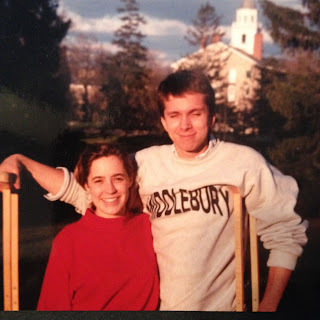 |
| We started dating in college, and we're still dating each other now, even though we're both married. I think you'd like her. |
Far more than the classes, she has changed my life. So often it's the people you meet--and not just the things you learn--that change you. I'm grateful to have met you both.
So thanks for being a Spanish teacher in a middle school in rural New York. Thanks for putting up with all of us kids in your classes, year after year. And thanks for taking my future seriously enough that you thought that my life, my travels, and my studies really mattered. You saw all that far more clearly than I did back then, but over the years I’ve come to see what you saw, and I’m forever grateful.
Your loving student,
Dave
On Paying Attention To Bear Poop - My recent TEDx talk in Fargo
The allegedly unnecessary things - like bear poop, and poetry - are often the things you most need to know.

I'm grateful to my friend Greg and his team for making this possible. I had no plans ever to do a TEDx talk until I met Greg through some mutual friends. We were having coffee here in Sioux Falls a few years ago, and I said something about the ecology of fish and forests. It must have resonated with Greg, because when I was done, he said "You should come to Fargo to give a TEDx talk!"
Some of the best things happen when you take time to have a cup of coffee or tea with friends, or when you meet new people, or when you find some bear scat on a trail by a river. Each of these things can be the prompting of a new thought, the spoor that shows you a new path.
Commerce, Environmental Attention, and the Liturgical Calendar
 |
| Bighorn sheep in the Badlands National Park. The animals move together, responding to the land. |
By "liturgy" I mean the work we do together on a regular basis. The word "liturgy" comes from two Greek words that mean "the work of the people," and it usually refers to the rituals of worship in a religious congregation: it's the formula for when and how and where we stand, sit, kneel, pray, etc.
Most religions I can think of have liturgical calendars that describe the regular cycle of rituals in a year. If liturgy usually refers to what we do when we gather for a holiday or a day of worship, a liturgical calendar organizes the year so that we know when those days occur. It usually gives a sense of the flow of time, connecting days to one another with some purpose: liturgical calendars connect
- fasts with feasts,
- days of rest with days of labor,
- celebration with food,
- the progress of our days with the progress of the skies,
- remembrance with anticipation,
- rejoicing with mourning.
 |
| Watching the seasons change: autumn leaves make imprints in the ice on my campus green. |
I used to think this was all silly, and a forced imposition on my freedom.
Lately I've been discovering that -- for me, at least -- the calendar's structure is a source of freedom from other calendars that don't help me to live well.
When I was younger I abandoned the liturgical calendar because I didn't want someone else telling me what days were holy. Why shouldn't they all be holy if I want them to be? And why should I fast just because someone else said we all should fast?
What I've come to see lately is that If we abandon the liturgical calendar with its times of feasting and fasting, the calendar doesn’t go away; it just becomes commercialized and turned into a calendar of constant consumption, constant labor. Feasting becomes purchasing; fasting becomes debt; and the two coincide with no time of rest between.
I experience the collapse of the calendar most where people like me have given it up and allowed others to co-opt it for commercial purposes. In simple terms, I experience it when I walk into a store in October and I hear Christmas music. All around me are ads telling me that my greatest obligation is to purchase things for Christmas, and to do so now.
This makes me want to shout: please spare me the Christmasy jingles, most of which drive me from your store. I like Christmas hymns, but the stress of being a cog in the machinery of holiday commerce has led me to appreciate the difference between Advent (a season of anticipation, of watching, and waiting) and Epiphany (a season of revealing, of celebration of birth, of discovery).
No one taught me this when I was young, but I've learned over the years that my tradition has different hymns for different times in the liturgical calendar. Now it feels odd to enter a pharmacy and to hear a hymn for the Nativity being played over the loudspeakers during Ordinary Time.
I used to think all that tradition to be nonsense. The older I get, the more I appreciate the thoughtful progress of a year, and the more I dislike the flattening of all days and all times into a yearlong, nonstop worship of commerce and toil.
We can't easily escape liturgical calendars, and I'm not sure we should. Even the birds of the air know when it is time to migrate, and they all have their liturgy of flight. The flowers know when to bloom, the salmon know when to spawn, the bears know when to look for the salmon. We humans used to know all these things, too.
Little by little we have lost connection to the liturgies that connect us to the land, the plants, the animals, the water, the wind, and the skies. When I ask my students what the phase of the moon is, it's rare that they know.
And I admit it is a wonderful thing not to need the moonlight. Running water, grocery stores, central heating, a solid roof, a functioning car, and many other modern conveniences are delightful. But they do come with costs; these good things are not free. They cost us money, which means we work more for them. And they have invisible costs, like the slow change of the quality of air in cities, the slow degradation of the planet's water, the slow loss of species around the world, the slow accumulation of things we throw away.
And then, when these slow processes pile up, we begin to notice them, and we begin to wonder: what have we done? We slowly gave up the liturgies of seedtime and harvest and replaced them with liturgical calendars in which all days are days of commerce and toil.
Which gives rise to new liturgies, urgent liturgies of anxiety. Look at what we have done, we say. With sackcloth and ashes we lament the fouling of our nest. As an environmental researcher, I see the fouling clearly and often, and I share that stress, that anxiety, that lamentation.
But if we replace the new liturgy of constant toil and waste with a newer one of constant lamentation over the toil and waste, we might wind up replacing one flattening of days with another.
 |
| Seedtime leads to harvest, and then seedtime again, with times of rest in between. |
I don't know the solution, and I don't intend to argue for returning to some halcyon past. Nor do I plan to argue for the imposition of my chosen calendar on others. But I do intend to reexamine the calendar I inherited, to dust it off and see what I missed when I put it aside. Sometimes old ideas are still good ones; some old seeds can still bear new fruit.
For now, what I propose is to mourn in some seasons, but also to rejoice in others. If there is mourning to do, it is also the case that there is still life to preserve. Each of these things--mourning and preserving, looking back at what is lost and looking ahead to what might flourish--calls for its own day. And each day calls for a calendar that can connect it to the other days in a way that keeps each day from dissolving into atomic time. Each day has some part of the whole of life. That part is worth seeing in its own day.