∞
Co-authorship in the Humanities
My friend and co-author John Kaag has just published this piece in today's New York Times.
I think John is right on the money: there aren't firm rules about this, but many times we've both been warned that co-authorship in the humanities will be regarded as a sign of weakness, of not being able to carry one's own weight.
Maybe it's true. John and I both find that co-authorship make us better writers, so we must have been weak in some ways. But I don't see why we shouldn't therefore do even more writing with others.
I think John is right on the money: there aren't firm rules about this, but many times we've both been warned that co-authorship in the humanities will be regarded as a sign of weakness, of not being able to carry one's own weight.
Maybe it's true. John and I both find that co-authorship make us better writers, so we must have been weak in some ways. But I don't see why we shouldn't therefore do even more writing with others.
∞
Spring Lilacs

∞
Popper On The Gift Of Wonder
“My first thesis is that every philosophy, and especially every philosophical ‘school,’ is liable to degenerate in such a way that its problems become practically indistinguishable from pseudo-problems, and its cant, accordingly, practically indistinguishable from meaningless babble. This, I shall try to show, is a consequence of philosophical inbreeding. The degeneration of philosophical schools in its turn is the consequence of the mistaken belief that one can philosophize without having been compelled to philosophize by problems outside philosophy—in mathematics, for example, or in cosmology, or in politics or in religion, or in social life. In other words my first thesis is this: Genuine philosophical problems are always rooted in urgent problems outside philosophy and they die if these roots decay. In their efforts to solve them, philosophers are liable to pursue what looks like a philosophical method or technique or an unfailing key to philosophical success. But no such methods or techniques exist, in philosophy methods are unimportant, any method is legitimate if it leads to results capable of being rationally discussed. What matters is not methods or techniques but a sensitivity to problems, and a consuming passion for them, or, as the Greeks said, the gift of wonder.”
-- Karl Popper, “The Nature of Philosophical Problems,” in Conjectures and Refutations: The Growth of Scientific Knowledge. (Routledge, 2002) 95. (Boldface emphasis mine.)
-- Karl Popper, “The Nature of Philosophical Problems,” in Conjectures and Refutations: The Growth of Scientific Knowledge. (Routledge, 2002) 95. (Boldface emphasis mine.)
∞
Free Stone
One spring after heavy rains had come and gone, my father and I walked the banks of the Sawkill Creek. It was newly scrubbed by floodwaters that had gouged its banks, sweeping away trees, glacial deposit boulders, and even a few buildings as the Catskills shed the rainfall and shot it down to the Hudson.
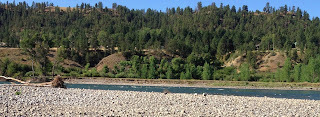
The memory of that short walk remains one of the strongest from my childhood. The river had cut new banks, and had changed its own course. We walked along the round gravel banks and gazed up at the undercut roots of massive oaks and pines. We saw the bones of the earth laid bare by the river's irresistible blade. The river had cut itself a new bed. Everything in its path was destroyed; everything in its path was made new.
Since then I have walked hundreds of miles along - and often in - deep, clear waters over cobbled riverbeds. The sound of the water is the music of my soul, high sprinkled notes of splashing water and bass tones of massive stones rocking back and forth in the current. Walking in freestone streams makes me forget my worries, forget time itself.

The memory of that short walk remains one of the strongest from my childhood. The river had cut new banks, and had changed its own course. We walked along the round gravel banks and gazed up at the undercut roots of massive oaks and pines. We saw the bones of the earth laid bare by the river's irresistible blade. The river had cut itself a new bed. Everything in its path was destroyed; everything in its path was made new.
 |
| Polished by the river. |
Since then I have walked hundreds of miles along - and often in - deep, clear waters over cobbled riverbeds. The sound of the water is the music of my soul, high sprinkled notes of splashing water and bass tones of massive stones rocking back and forth in the current. Walking in freestone streams makes me forget my worries, forget time itself.
∞
Mersenne, Education, and Intellectual "Property"
French cleric Marin Mersenne was the academic journal of his day. I have heard it said that in the seventeenth century the saying was "If you want to tell Europe, tell Mersenne."
Hobbes mentions Mersenne several times in his verse autobiography - high praise for a Roman Catholic cleric from someone whose antipathy for the Roman church and its philosophy was both deep and wide. But when Hobbes needed friends during his exile in France, Mersenne was glad to be one of those friends. Mersenne was a friend to all who were engaged in research. He was a living example of that idea of Justin Martyr's that Christians need not fear any books at all, since all the truth they contain belongs to the God who made and sustains it.
He was a friend to Galileo, and he passed Galileo's research on the regular oscillation of pendula along to Huygens in Holland, since he knew Huygens was trying to invent a more regular way of keeping time, leading to the invention of the pendulum clock. He corresponded with Pascal, Gassendi, and Descartes, and what he learned from one he shared with others who could use it.
In his Carnage and Culture, Victor Davis Hanson claims that one of the reasons for technological flourishing in the west is that western cultures treat knowledge as property that can be sold in the marketplace. I can't say whether Hanson's causal inference is correct, but his observation about intellectual "property" is acute.
But alongside it we should add another observation, namely that universities have long been places where ideas are exchanged freely. Yes, students pay tuition, but we also give free public lectures, allow free or inexpensive auditing, etc. What is being sold in the university is not the information but the cost of maintaining a place of intentional colloquy and pedagogy. We aren't selling ideas to students; we are allowing them to join us in the maintenance of a vital institution, and as members of that institution they participate in its life and share in its learning.
Mersenne was not a merchant of ideas but their curator, a steward ushering them to the places they were most needed. He was a gardener who made very few original contributions but who shared the best cultivars he could find with others in whose gardens they could flourish. His approach to knowledge was like that of the church in its earliest years, where "no one claimed private ownership of any possessions, but everything they owned was held in common" and goods were "distributed to each as they had need."
Mersenne's model is relevant to our contemporary conversations about the meaning and cost of an education, the value of universities, and the publication of scientific journals. Some money will be needed to maintain these institutions, but we should resist reducing them to market-based enterprises, or valuing their contributions in terms of revenues. There is also the shared work of curiosity, and of desiring to see our neighbors, and their ideas, flourish.
Hobbes mentions Mersenne several times in his verse autobiography - high praise for a Roman Catholic cleric from someone whose antipathy for the Roman church and its philosophy was both deep and wide. But when Hobbes needed friends during his exile in France, Mersenne was glad to be one of those friends. Mersenne was a friend to all who were engaged in research. He was a living example of that idea of Justin Martyr's that Christians need not fear any books at all, since all the truth they contain belongs to the God who made and sustains it.
He was a friend to Galileo, and he passed Galileo's research on the regular oscillation of pendula along to Huygens in Holland, since he knew Huygens was trying to invent a more regular way of keeping time, leading to the invention of the pendulum clock. He corresponded with Pascal, Gassendi, and Descartes, and what he learned from one he shared with others who could use it.
In his Carnage and Culture, Victor Davis Hanson claims that one of the reasons for technological flourishing in the west is that western cultures treat knowledge as property that can be sold in the marketplace. I can't say whether Hanson's causal inference is correct, but his observation about intellectual "property" is acute.
But alongside it we should add another observation, namely that universities have long been places where ideas are exchanged freely. Yes, students pay tuition, but we also give free public lectures, allow free or inexpensive auditing, etc. What is being sold in the university is not the information but the cost of maintaining a place of intentional colloquy and pedagogy. We aren't selling ideas to students; we are allowing them to join us in the maintenance of a vital institution, and as members of that institution they participate in its life and share in its learning.
Mersenne was not a merchant of ideas but their curator, a steward ushering them to the places they were most needed. He was a gardener who made very few original contributions but who shared the best cultivars he could find with others in whose gardens they could flourish. His approach to knowledge was like that of the church in its earliest years, where "no one claimed private ownership of any possessions, but everything they owned was held in common" and goods were "distributed to each as they had need."
Mersenne's model is relevant to our contemporary conversations about the meaning and cost of an education, the value of universities, and the publication of scientific journals. Some money will be needed to maintain these institutions, but we should resist reducing them to market-based enterprises, or valuing their contributions in terms of revenues. There is also the shared work of curiosity, and of desiring to see our neighbors, and their ideas, flourish.
∞
Light Perpetual
My friend Michael Foster died last night.
We knew it was coming. We saw it a long way off.
It still hurts like hell.
That's what this bereavement feels like: a little piece of hell. Our word "bereave" shares roots with "robbery," "rupture," and "interrupt." Something has been stolen from us, something has been broken, broken off. It should not be this way.
The words of Mark Heard's song "Treasure of the Broken Land" are going through my mind again and again:
The realization that he is gone keeps hitting me in waves. Now, as I write this, I keep having to stop as my throat constricts and my heart pounds, waiting for the tremor to pass through me, waiting for this wave of anguish to roll over me.
Maybe telling some of his story - our story - will help.
I met Mike when I was a grad student at Penn State. He was a professor at Penn State, and a sub-deacon at our church. (This means he helped with bread and wine, and looked good in a dress.) We both attended St Andrew's Episcopal Church in State College, and together we served on the vestry.
Sometime in my last year or two of grad work - I don't remember exactly; odd how the most important things can seem so commonplace - he invited me to go out to breakfast at the Corner Room. Like so many other kind professors I knew, he insisted on paying. (I now do the same with my students; the little things that mark our lives often become the lessons we really teach.)
Mike was trying to live the best life he could, using his scholarly discipline to love his neighbor, and trying to love his God to the best of his ability. He'd begun reading Dallas Willard's book The Divine Conspiracy, a book about becoming an intentional follower of Christ. I knew Willard's work on Husserl, and I guess Mike figured that made me a good conversation partner. We started meeting every week; he'd buy me breakfast and we'd talk about another chapter of Willard's book.
I didn't know what to make of Willard, and I was reading a lot of other books (this is the life of a grad student, after all) so the book didn't sink in much. But Mike's life did. Mostly we let the book lead us to talking about how we were living, and why we did what we did. Mike had studied economics, and recently his work had become really important to him as he discovered how to combine the methods of his discipline and of developmental psychology to advocate for poor children. His field was not mine, but I gathered that this was the upshot: a little money invested in children will pay dividends in their lives forever.
Mike was a restless soul, like Augustine, only finding his rest in God. I've lost count of how many times he and Mary and their four kids moved, but I know we've visited them in North Carolina and Alabama since we all left Pennsylvania. He wasn't afraid to pull up his stakes and move somewhere else if he thought he could do better work there. He has urged me, several times, to do the same, to be willing to regard tenure as a shackle rather than a privilege, and to move where the spirit moves me.
A few years ago Mike was diagnosed with a tumor in his brain. He approached this with the same doggedness he approached everything else. He poured himself into researching treatments, and flew all over the country seeking good medical advice. The tumor was removed at the cost of one of his eyes, and he went through some grueling radiation. (I long for the day when we will look back on our modern cancer treatments the way we now look back on bloodletting.) A little over a year ago he was at Mayo, not too far from me. I drove over to see him and Mary, and they gave me the gift of letting me pray for them. I say this is a gift, because I am at best a fumbling prayer, and they made me feel like a priest. They were suffering, and here they were, giving me this gift of unmerited affirmation.
Last summer a friend from Australia passed through Sioux Falls while enjoying a long service leave. He had rented a car and was driving from Seattle to Birmingham. I took advantage of my sabbatical and hopped in the car with him so I could visit Mike and Mary. They'd just moved to a new home, everything was in boxes, Mike's tumor was growing again, and yet they took me in and made me feel like I was long-lost family recently found again.
I loved talking with Mike, because his offhand observations were like gold. And the way he talked to people, and treated people, were always examples of both wit and grace. He was kind, and that allowed him to talk straight, to say with smiling integrity and southern charm, exactly what he was thinking. He was a true Israelite, in whom there wasn't much guile, and the guile that was there made him fun, and good company. I loved the way he loved his wife, and his kids. He wore that on the outside, not for show, but because his love was too big to keep on the inside. I'm sure it was flawed, as all loves are, but it was also intentional, the centerpiece of his life.
A couple of months ago, Mike asked if we could talk. You never know when the conversation you have will be the last one you ever have; this was ours. He told me the doctor had bad news: he might make it to Christmas, but not likely past that.
Mike asked me if he had lived right, if he had done the right thing. Yes, oh yes, Mike. I don't see as God sees, but I don't see how God could say otherwise. You made my life better. You loved well, in everything you did.
He also asked me if it was okay to ask God for healing. This one was harder to answer, but I decided that after thirteen years of benefiting from his straight talk, from free breakfasts and warm hospitality, I owed him nothing less than that. "It's okay to ask, Mike," I hesitated, not wanting to say it, not wanting to believe what would come next. I could hear in his conversation that he was declining, that his memory was being eaten away by the tumor. "But God's not required to answer those prayers. Miracles happen, but we call them miracles because they're rare. Christ died, and you and I will die too. It's time to start thinking about passing your work on to others."
His work was so good, too. He was at a new hinge-point, a pivot on which his research was ready to swing hard at injustice. He could see how ten more years of work - even two more years of work - would make a big difference. "I've got so much more to do; why is God taking me away now?" he asked. "I don't know, Mike. I just don't know."
Once again, as his last gift to me, he asked me to pray for him. It was hard to find the words, but I tried to talk to God the way Mike talked to me, letting Mike's life be a lesson in prayer. I don't like what you're doing, God. Make it better, make it right.
I suppose it is better for Mike not to be suffering, but Mike's death doesn't seem better, or right to me. I want him back, God. I know I can't have him back, not yet, but I miss him and it hurts.
If I cannot have him back, then give us this: a double portion of his spirit. The world is darker without him. I cannot see for the tears in my eyes; I cannot hear his voice anymore. I don't know how to pray. Give me his courage, and his wisdom, and his love. Let him be enshrined in me. Let all that was good in him live in my life now, and in the lives of his wife, his children, his students. Oh, this is the hard thing to ask: let us continue his work, with his spirit.
Mark Heard's words give me some hope:
Update: If you'd like to attend the memorial service on Wednesday, May 22, you may find details here. Mike asked that we wear bright colors, not black, to celebrate his life and to maintain our hope for the future.
We knew it was coming. We saw it a long way off.
It still hurts like hell.
That's what this bereavement feels like: a little piece of hell. Our word "bereave" shares roots with "robbery," "rupture," and "interrupt." Something has been stolen from us, something has been broken, broken off. It should not be this way.
The words of Mark Heard's song "Treasure of the Broken Land" are going through my mind again and again:
I thought our days were commonplaceI knew our days didn't number in the millions, but that's what my heart longed for, Mike. The loss hurts like hell because the time spent with you felt like heaven, like something that was meant to be eternal.
I thought they numbered in the millions
Now there's only the aftertaste
Of circumstance that can't pass this way again.
The realization that he is gone keeps hitting me in waves. Now, as I write this, I keep having to stop as my throat constricts and my heart pounds, waiting for the tremor to pass through me, waiting for this wave of anguish to roll over me.
Maybe telling some of his story - our story - will help.
I met Mike when I was a grad student at Penn State. He was a professor at Penn State, and a sub-deacon at our church. (This means he helped with bread and wine, and looked good in a dress.) We both attended St Andrew's Episcopal Church in State College, and together we served on the vestry.
Sometime in my last year or two of grad work - I don't remember exactly; odd how the most important things can seem so commonplace - he invited me to go out to breakfast at the Corner Room. Like so many other kind professors I knew, he insisted on paying. (I now do the same with my students; the little things that mark our lives often become the lessons we really teach.)
Mike was trying to live the best life he could, using his scholarly discipline to love his neighbor, and trying to love his God to the best of his ability. He'd begun reading Dallas Willard's book The Divine Conspiracy, a book about becoming an intentional follower of Christ. I knew Willard's work on Husserl, and I guess Mike figured that made me a good conversation partner. We started meeting every week; he'd buy me breakfast and we'd talk about another chapter of Willard's book.
I didn't know what to make of Willard, and I was reading a lot of other books (this is the life of a grad student, after all) so the book didn't sink in much. But Mike's life did. Mostly we let the book lead us to talking about how we were living, and why we did what we did. Mike had studied economics, and recently his work had become really important to him as he discovered how to combine the methods of his discipline and of developmental psychology to advocate for poor children. His field was not mine, but I gathered that this was the upshot: a little money invested in children will pay dividends in their lives forever.
 |
| Mike and I stand together in the Dexter Ave King Memorial Church |
A few years ago Mike was diagnosed with a tumor in his brain. He approached this with the same doggedness he approached everything else. He poured himself into researching treatments, and flew all over the country seeking good medical advice. The tumor was removed at the cost of one of his eyes, and he went through some grueling radiation. (I long for the day when we will look back on our modern cancer treatments the way we now look back on bloodletting.) A little over a year ago he was at Mayo, not too far from me. I drove over to see him and Mary, and they gave me the gift of letting me pray for them. I say this is a gift, because I am at best a fumbling prayer, and they made me feel like a priest. They were suffering, and here they were, giving me this gift of unmerited affirmation.
Last summer a friend from Australia passed through Sioux Falls while enjoying a long service leave. He had rented a car and was driving from Seattle to Birmingham. I took advantage of my sabbatical and hopped in the car with him so I could visit Mike and Mary. They'd just moved to a new home, everything was in boxes, Mike's tumor was growing again, and yet they took me in and made me feel like I was long-lost family recently found again.
I loved talking with Mike, because his offhand observations were like gold. And the way he talked to people, and treated people, were always examples of both wit and grace. He was kind, and that allowed him to talk straight, to say with smiling integrity and southern charm, exactly what he was thinking. He was a true Israelite, in whom there wasn't much guile, and the guile that was there made him fun, and good company. I loved the way he loved his wife, and his kids. He wore that on the outside, not for show, but because his love was too big to keep on the inside. I'm sure it was flawed, as all loves are, but it was also intentional, the centerpiece of his life.
A couple of months ago, Mike asked if we could talk. You never know when the conversation you have will be the last one you ever have; this was ours. He told me the doctor had bad news: he might make it to Christmas, but not likely past that.
Mike asked me if he had lived right, if he had done the right thing. Yes, oh yes, Mike. I don't see as God sees, but I don't see how God could say otherwise. You made my life better. You loved well, in everything you did.
He also asked me if it was okay to ask God for healing. This one was harder to answer, but I decided that after thirteen years of benefiting from his straight talk, from free breakfasts and warm hospitality, I owed him nothing less than that. "It's okay to ask, Mike," I hesitated, not wanting to say it, not wanting to believe what would come next. I could hear in his conversation that he was declining, that his memory was being eaten away by the tumor. "But God's not required to answer those prayers. Miracles happen, but we call them miracles because they're rare. Christ died, and you and I will die too. It's time to start thinking about passing your work on to others."
His work was so good, too. He was at a new hinge-point, a pivot on which his research was ready to swing hard at injustice. He could see how ten more years of work - even two more years of work - would make a big difference. "I've got so much more to do; why is God taking me away now?" he asked. "I don't know, Mike. I just don't know."
Once again, as his last gift to me, he asked me to pray for him. It was hard to find the words, but I tried to talk to God the way Mike talked to me, letting Mike's life be a lesson in prayer. I don't like what you're doing, God. Make it better, make it right.
I suppose it is better for Mike not to be suffering, but Mike's death doesn't seem better, or right to me. I want him back, God. I know I can't have him back, not yet, but I miss him and it hurts.
If I cannot have him back, then give us this: a double portion of his spirit. The world is darker without him. I cannot see for the tears in my eyes; I cannot hear his voice anymore. I don't know how to pray. Give me his courage, and his wisdom, and his love. Let him be enshrined in me. Let all that was good in him live in my life now, and in the lives of his wife, his children, his students. Oh, this is the hard thing to ask: let us continue his work, with his spirit.
Mark Heard's words give me some hope:
I see you now and then in dreamsMay light perpetual shine upon you, Mike. May I see you, and hear you, in my dreams. May the light of Christ that shone in you while you were awake now shine in us while you sleep. And may we all awake to the same dawn, soon.
Your voice sounds like it used to
I believe I will hear it again
God, how I love you!
*****
Update: If you'd like to attend the memorial service on Wednesday, May 22, you may find details here. Mike asked that we wear bright colors, not black, to celebrate his life and to maintain our hope for the future.
∞
I've been saying it to my students for years: more than just about any other group of non-scientists, hunters and fishers know the land we live on. This means that they also are the ones who most notice changes, just as you notice when something in your home is moved to a new place.
This article in Outside makes just this case, with the additional point that we who seek our food in the wild are the people who ought to be advocating for real conservation: not just changes to game laws, but changes in the way we live in relationship to our world.
Hunting, Fishing, and Climate Change
 |
| Trout angling in the Black Hills of South Dakota |
This article in Outside makes just this case, with the additional point that we who seek our food in the wild are the people who ought to be advocating for real conservation: not just changes to game laws, but changes in the way we live in relationship to our world.
∞
Visual Art and the Sacred: On The Importance Of Museums
I just finished writing an essay about the day Picasso made me fall down. I'm sending it off to my favorite editor, and if it's accepted, I'll post a link here.
The event I wrote about took place over two decades ago, when Picasso's Guernica was still housed in the Casón del Buen Retiro at the Prado Museum in Madrid. (It is now in the Reina Sofia, in a larger but - in my opinion - far inferior room. You can learn a bit about that here.)
Meanwhile, here's the upshot of my essay: education that's prepackaged and canned is not enough. Education is not the same as transferring information.
It involves informing students, to be sure, but what we tell students
should not satisfy them; it should provoke them to want more. Professors are not conduits of data; at our best we are like guides and gardeners.
As guides we point students in new directions and help them to see what
we see. Just as gardeners cannot make seeds grow but can prepare the
soil, so our teaching should be about increasing the fertility of minds
and then stepping back to watch what grows. Also, there is occasional
weeding involved.
As an undergraduate I knew very little about art. Part of this was my disposition: I liked representational art that was easy to look at quickly. Part of it was a matter of my worldview, and the suspicion that some modern artists who eschewed representational art were trying to undermine something good, obscurantists clouding clear vision.
Time spent in museums has changed me a good deal, as has making the acquaintance of Scott Parsons and Daniel Siedell, who have helped me quite a lot through their patient conversation and what they have written. (Scott and I wrote a chapter on teaching students about visual culture and the sacred in Ronald Bernier's short but illuminating book Beyond Belief, in which Dan also has a chapter.) Some of Makoto Fujimura's short writings, James Elkins's book On the Strange Place of Religion in Modern Art, and Gregory Wolfe's work at Image have also provided me with clear and helpful education about art that I resisted when I was younger.
Museums are certainly controversial. Curators make decisions that both expand and limit what we see, and this can be exploited to achieve sordid political ends. Some ideas and cultures are given preferential treatment while others are made less known by their omission. They tend to be located in large, wealthy cities, which means that poor people, rural people, and foreigners have limited or no access to them. But if the alternative is no museums, or all of the world's artifacts in private collections, I will take the museums we have, coupled with ever striving to make them better.
Because museums are a tangible way we can commit to remembering our history together. Museums are not safe deposit boxes where we lock away our treasures; they are Wunderkammers and classrooms where we may think and learn together.
I have come to love museums, especially the British Museum and the beautiful New Acropolis Museum in Athens (and I'm aware of the irony of that pairing) but I also love the little museums I find in small towns the world over.
The event I wrote about took place over two decades ago, when Picasso's Guernica was still housed in the Casón del Buen Retiro at the Prado Museum in Madrid. (It is now in the Reina Sofia, in a larger but - in my opinion - far inferior room. You can learn a bit about that here.)
 |
| New Acropolis Museum, Athens |
As an undergraduate I knew very little about art. Part of this was my disposition: I liked representational art that was easy to look at quickly. Part of it was a matter of my worldview, and the suspicion that some modern artists who eschewed representational art were trying to undermine something good, obscurantists clouding clear vision.
Time spent in museums has changed me a good deal, as has making the acquaintance of Scott Parsons and Daniel Siedell, who have helped me quite a lot through their patient conversation and what they have written. (Scott and I wrote a chapter on teaching students about visual culture and the sacred in Ronald Bernier's short but illuminating book Beyond Belief, in which Dan also has a chapter.) Some of Makoto Fujimura's short writings, James Elkins's book On the Strange Place of Religion in Modern Art, and Gregory Wolfe's work at Image have also provided me with clear and helpful education about art that I resisted when I was younger.
Museums are certainly controversial. Curators make decisions that both expand and limit what we see, and this can be exploited to achieve sordid political ends. Some ideas and cultures are given preferential treatment while others are made less known by their omission. They tend to be located in large, wealthy cities, which means that poor people, rural people, and foreigners have limited or no access to them. But if the alternative is no museums, or all of the world's artifacts in private collections, I will take the museums we have, coupled with ever striving to make them better.
Because museums are a tangible way we can commit to remembering our history together. Museums are not safe deposit boxes where we lock away our treasures; they are Wunderkammers and classrooms where we may think and learn together.
I have come to love museums, especially the British Museum and the beautiful New Acropolis Museum in Athens (and I'm aware of the irony of that pairing) but I also love the little museums I find in small towns the world over.
∞
What Jesus Didn't Say
My latest contribution to Sojourners' "God's Politics" blog.
Some reflections on the surprising encounter between Jesus and the Samaritan woman he meets at the well in the fourth chapter of John's Gospel. Here's a little taste of the post:
Some reflections on the surprising encounter between Jesus and the Samaritan woman he meets at the well in the fourth chapter of John's Gospel. Here's a little taste of the post:
"We can get a lot of attention in the media by self-righteous grandstanding, but wouldn’t it be better to follow the example Jesus sets here? Rather than telling people caught in desperate sin how far their sin has removed them from God, why not invite them to come to worship?"
∞
Pornography and Prayer
A recent Wall Street Journal article talks about the way online pornography quickly develops new neural pathways that are difficult to undo. As the author puts it,
To put it differently, everyone worships something, and what we worship changes us. This is one of the good reasons to engage in prayer and worship that are intentional. (On a related note, it's a good reason to forgive, too: forgiveness keeps us from internalizing the pain others have caused us, where it can fester and devour us from within.)
(If you read my writing with any regularity you will recognize these as themes I frequently return to. If you're interested, I've written more here and here.)
One of the problems of philosophy of religion has been to try to identify that which certainly deserves our worship. This quest for certainty has often (in my view) distracted us from the more important work of liturgy, wherein we acknowledge our limitations, including our uncertainty. A good liturgy involves worshiping what we believe to be worth worshiping, while acknowledging our own limitations. After all, if worship doesn't include humility on the part of the worshiper, it is probably self-worship.
Another way of putting this is in terms of love. Charles Peirce wrote about this more than a century ago. There are many forms of worship, many kinds of prayer. Without intending to demean the prayer and worship of others, Peirce nevertheless offers what seems to him to be worth our attention: agape love, the love that seeks to nurture others:
I am not trying to moralize about pornography. In fact, I see some good in pornography, just as I recognize goodness in the aromas coming from a kitchen where good cooking happens. Pornography probably speaks to some of our most basic desires and needs, for intimacy, affection, attention, and love, as well as our simple, animal longings.
Still, like aromas from a fine kitchen, porn stimulates us without nourishing us. And by giving it too much attention we may be training ourselves to scorn good nutrition. The WSJ article suggests giving up the stimulation as a means of getting over it. I think this is incomplete without a redirection of the attention to what does in fact nourish us. Prayer and worship that refocus our conscious minds on what really merits our attention can prepare us to receive - and to give - good nutrition. That is, by shifting some of our attention from cherishing need-love to cherishing gift-love - from the love that uses others to the love that seeks their flourishing - we might make ourselves into the kind of great lovers our world most needs.
"Repetitive viewing of pornography resets neural pathways, creating the need for a type and level of stimulation not satiable in real life. The user is thrilled, then doomed."Thankfully, "doomed" may be an overstatement. As William James and so many others remind us, our habits make us who we are, so we may be able to form new habits to supplant or redirect old ones. I'm no psychologist, but it seems obvious to me that what we hold in front of our consciousness will synechistically affect everything else we think about and do. So it is no surprise that the author of this WSJ article reports that viewing porn may lead to viewing women as things rather than as people.
To put it differently, everyone worships something, and what we worship changes us. This is one of the good reasons to engage in prayer and worship that are intentional. (On a related note, it's a good reason to forgive, too: forgiveness keeps us from internalizing the pain others have caused us, where it can fester and devour us from within.)
(If you read my writing with any regularity you will recognize these as themes I frequently return to. If you're interested, I've written more here and here.)
One of the problems of philosophy of religion has been to try to identify that which certainly deserves our worship. This quest for certainty has often (in my view) distracted us from the more important work of liturgy, wherein we acknowledge our limitations, including our uncertainty. A good liturgy involves worshiping what we believe to be worth worshiping, while acknowledging our own limitations. After all, if worship doesn't include humility on the part of the worshiper, it is probably self-worship.
Another way of putting this is in terms of love. Charles Peirce wrote about this more than a century ago. There are many forms of worship, many kinds of prayer. Without intending to demean the prayer and worship of others, Peirce nevertheless offers what seems to him to be worth our attention: agape love, the love that seeks to nurture others:
"Man's highest developments are social; and religion, though it begins in a seminal individual inspiration, only comes to full flower in a great church coextensive with a civilization. This is true of every religion, but supereminently so of the religion of love. Its ideal is that the whole world shall be united in the bond of a common love of God accomplished by each man's loving his neighbour. Without a church, the religion of love can have but a rudimentary existence; and a narrow, little exclusive church is almost worse than none. A great catholic church is wanted." (Peirce, Collected Papers, 6.442-443)Notice that Peirce uses a small "c" in "catholic." He wasn't trying to proselytize for one sect; quite the opposite. He was trying to proclaim the importance of a church - that is, of a community that shares a commitment to communal worship - of nurturing love.
I am not trying to moralize about pornography. In fact, I see some good in pornography, just as I recognize goodness in the aromas coming from a kitchen where good cooking happens. Pornography probably speaks to some of our most basic desires and needs, for intimacy, affection, attention, and love, as well as our simple, animal longings.
Still, like aromas from a fine kitchen, porn stimulates us without nourishing us. And by giving it too much attention we may be training ourselves to scorn good nutrition. The WSJ article suggests giving up the stimulation as a means of getting over it. I think this is incomplete without a redirection of the attention to what does in fact nourish us. Prayer and worship that refocus our conscious minds on what really merits our attention can prepare us to receive - and to give - good nutrition. That is, by shifting some of our attention from cherishing need-love to cherishing gift-love - from the love that uses others to the love that seeks their flourishing - we might make ourselves into the kind of great lovers our world most needs.
∞
Spammer, Think Of Your Soul
I am barraged by spam and robocalls. Most of the email I get is spam, and similarly most of the calls I get are from machines that have been programmed to try to sell me something.
There are several things that bother me about this. One of the simplest is that I am receiving so many calls and emails that I don't want. The emails are a small bother; my spam filter catches some, and I delete the rest. It's tedious but tolerable. The robocalls are a bigger bother, because they've trained me to no longer answer the phone. Everything goes to voicemail unless I recognize the call as coming from a friend or family member.
But what bothers me most is the exclusion of rational conversation. I would love to be able to tell the spammers and robocallers that I, on principle, do not make impulse buys. I do not respond to any emailed ads, and I never buy something offered to me by a stranger over the phone. Nothing you send my way will interest me. In fact, just sending it my way, unsolicited, elicits the opposite response in me.
There is no way to say this, though. There is no conversation to be had. For a while I did answer the phone, and I asked the callers to remove my number from their lists. Until one caller told me, in no uncertain terms, that he would not do so. "But the law requires it," I protested. "No, you motherf***er," he said, "I will not, and there's nothing you can do about it." I protested again, and he again repeated his coarse epithet. There was no conversation to be had with him, unless I was willing to be his cash-provider. To him, I was not even a potential customer. I was a motherf***er, something not to be conversed with, but to be used for income.
One strong appeal of reason is that it is a substitute for violence. If we both want the same thing, we can reason together about whether it is possible to share resources, to take turns, to seek goods elsewhere. If we have a dispute, we do not need to resort to blows; we can seek a resolution in mutually acceptable terms. But we can only do this if our differences can be mediated by reason. When conversation is cut off absolutely, reason's reach is cut short.
Treating other people solely as means to income rather than as ends worthy of their own consideration independent of my interests cuts off conversation by deciding in advance that these mere means can have nothing to say that is worth listening to.
This angers me. In the ten minutes it has taken me to write this, I have received eight emails, seven of them spam. So I must say it here, even if I cannot say it to those who so mistreat me: I will continue to long for your rationality, for your willingness to remain within the bonds of society. But you must know that the habits of your capitalism are not only illegal but unethical and unkind. Which means that you are cutting yourself off from the people around you, one habit at a time. You may be gaining wealth, but what will you do with it? What will it profit you to gain the whole world and to lose the people around you, to lose your very soul? You may think you are gaining, but with each email sent, with each call made, you are spending a sliver of what makes you part of the community of humankind.
There are several things that bother me about this. One of the simplest is that I am receiving so many calls and emails that I don't want. The emails are a small bother; my spam filter catches some, and I delete the rest. It's tedious but tolerable. The robocalls are a bigger bother, because they've trained me to no longer answer the phone. Everything goes to voicemail unless I recognize the call as coming from a friend or family member.
But what bothers me most is the exclusion of rational conversation. I would love to be able to tell the spammers and robocallers that I, on principle, do not make impulse buys. I do not respond to any emailed ads, and I never buy something offered to me by a stranger over the phone. Nothing you send my way will interest me. In fact, just sending it my way, unsolicited, elicits the opposite response in me.
There is no way to say this, though. There is no conversation to be had. For a while I did answer the phone, and I asked the callers to remove my number from their lists. Until one caller told me, in no uncertain terms, that he would not do so. "But the law requires it," I protested. "No, you motherf***er," he said, "I will not, and there's nothing you can do about it." I protested again, and he again repeated his coarse epithet. There was no conversation to be had with him, unless I was willing to be his cash-provider. To him, I was not even a potential customer. I was a motherf***er, something not to be conversed with, but to be used for income.
One strong appeal of reason is that it is a substitute for violence. If we both want the same thing, we can reason together about whether it is possible to share resources, to take turns, to seek goods elsewhere. If we have a dispute, we do not need to resort to blows; we can seek a resolution in mutually acceptable terms. But we can only do this if our differences can be mediated by reason. When conversation is cut off absolutely, reason's reach is cut short.
Treating other people solely as means to income rather than as ends worthy of their own consideration independent of my interests cuts off conversation by deciding in advance that these mere means can have nothing to say that is worth listening to.
This angers me. In the ten minutes it has taken me to write this, I have received eight emails, seven of them spam. So I must say it here, even if I cannot say it to those who so mistreat me: I will continue to long for your rationality, for your willingness to remain within the bonds of society. But you must know that the habits of your capitalism are not only illegal but unethical and unkind. Which means that you are cutting yourself off from the people around you, one habit at a time. You may be gaining wealth, but what will you do with it? What will it profit you to gain the whole world and to lose the people around you, to lose your very soul? You may think you are gaining, but with each email sent, with each call made, you are spending a sliver of what makes you part of the community of humankind.
∞
Unwritten
Some of my favorite passages in any texts are about texts
that cannot be read.
Take the story of a man writing on the ground with his finger thousands of years ago. We do not know what he wrote, we only know that he wrote.
The story is in John’s Gospel, and the scene was this: some men brought Jesus a woman whom, they said, they had caught in adultery.
The passage does not occur in the oldest manuscripts, but it appears in some that are old enough that this pericope has been included in the canonical text.
And it is a delicious passage.
For one thing, it reminds us that even if we have the whole of the Scriptures, we still do not know everything Jesus said or wrote. Or thought.
It is one of the blank spaces in which commentary has not yet been written. Which makes it an invitation to imagine – not to devise religious rules on the basis of conjecture, but to engage in the work of strenuous wonder: what might he have written?
I came up with an answer once, and Merold Westphal put it even better in his book Suspicion and Faith. I won’t spoil it for you by telling you now.
In his writing on Aristotle, Charles Peirce sometimes invokes “that scamp, Apellicon,” the ancient editor of Aristotle's texts. Peirce charges him with altering Aristotle’s texts so that we now must guess at what Aristotle really wrote. (And by "guess" I mean a long and difficult reasoning process involving imagination and testing of hypotheses, not just wild conjectures.)
As I have read Peirce’s manuscripts, occasionally I’ve wanted to curse some unknown scamp who mishandled Peirce’s papers (perhaps Peirce himself) as when he will say “see my note on page 18 of this manuscript” and then I discover that the manuscript is incomplete, ending on page 17.
So I have to guess. What might Peirce have written?
Take the story of a man writing on the ground with his finger thousands of years ago. We do not know what he wrote, we only know that he wrote.
The story is in John’s Gospel, and the scene was this: some men brought Jesus a woman whom, they said, they had caught in adultery.
The passage does not occur in the oldest manuscripts, but it appears in some that are old enough that this pericope has been included in the canonical text.
And it is a delicious passage.
For one thing, it reminds us that even if we have the whole of the Scriptures, we still do not know everything Jesus said or wrote. Or thought.
It is one of the blank spaces in which commentary has not yet been written. Which makes it an invitation to imagine – not to devise religious rules on the basis of conjecture, but to engage in the work of strenuous wonder: what might he have written?
I came up with an answer once, and Merold Westphal put it even better in his book Suspicion and Faith. I won’t spoil it for you by telling you now.
In his writing on Aristotle, Charles Peirce sometimes invokes “that scamp, Apellicon,” the ancient editor of Aristotle's texts. Peirce charges him with altering Aristotle’s texts so that we now must guess at what Aristotle really wrote. (And by "guess" I mean a long and difficult reasoning process involving imagination and testing of hypotheses, not just wild conjectures.)
As I have read Peirce’s manuscripts, occasionally I’ve wanted to curse some unknown scamp who mishandled Peirce’s papers (perhaps Peirce himself) as when he will say “see my note on page 18 of this manuscript” and then I discover that the manuscript is incomplete, ending on page 17.
So I have to guess. What might Peirce have written?
Aldo Leopold wrote about this in his essay “The River of the Mother of God,” which was named for a river on an old map of South America. Some explorer had come upon the river in
the wilderness but did not know where it began or ended, so he drew a short
section of river without beginning or end, leaving it to future cartographers
to fill in the unknown sections.
It’s good to have some mysteries, some lacunae in our
knowledge.
Or rather, it’s good to be aware of some of the gaps in what we know.
As Socrates knew, this awareness of our own limitations is
one of the beginnings of the love of wisdom.
From there, curiosity draws us further on.
∞
Bicycles Belong On The Road
Road Rage
As I've shared yesterday's story about the Sioux Falls driver who assaulted a bicyclist, other bicyclists I know have shared similar stories. It seems all the serious riders I know have had run-ins with motorists who refuse to acknowledge their right to the road.
Many of us are fast enough that we come pretty close to riding at the speed limit, so we're not really slowing things down. Most of our major streets in Sioux Falls are wide enough to permit sharing the lane - giving motorists enough room to obey the three-foot buffer mandated by city law.
Should we bike on the sidewalk? No!
But even slow cyclists have a right to the roads. Drivers sometimes tell me to bike on the sidewalk. If they weren't driving away so fast, I'd take the time to let them know what a stupid idea that is.
If you're one of those drivers who wonders why I'm not on the sidewalk, here's why:
So not only do we have the legal right to be on the road and to occupy the lane, as you can see, biking is our best option.
And no, driving is not our best option. I will admit that if you're driving a car that weighs several tons, you're safer than I am when I'm straddling a twenty-pound aluminum frame. But what I'm doing is better for all of us, even for you. Think about it:
You and I have the right to drive on public roads maintained at public expense because we all agree it is worth paying for, and the laws make it possible and safe. Those same laws, and that same public opinion, supports the right of bicyclists to use those same roads.
As I've shared yesterday's story about the Sioux Falls driver who assaulted a bicyclist, other bicyclists I know have shared similar stories. It seems all the serious riders I know have had run-ins with motorists who refuse to acknowledge their right to the road.
Many of us are fast enough that we come pretty close to riding at the speed limit, so we're not really slowing things down. Most of our major streets in Sioux Falls are wide enough to permit sharing the lane - giving motorists enough room to obey the three-foot buffer mandated by city law.
Should we bike on the sidewalk? No!
But even slow cyclists have a right to the roads. Drivers sometimes tell me to bike on the sidewalk. If they weren't driving away so fast, I'd take the time to let them know what a stupid idea that is.
If you're one of those drivers who wonders why I'm not on the sidewalk, here's why:
- It's more dangerous. People pulling out of driveways don't look at who is coming down the sidewalk. Try this sometime and you'll see what I mean. You probably don't look either.
- It's more dangerous. Sidewalks are for walking. I think that's why they're called sidewalks. (See that word "walk" in there?) Which means that they're not engineered for biking. Telephone poles and guy wires and signposts for motorists jut out of and across sidewalks all over town, making it easy for anyone going at a decent pace to get knocked off their bikes.
- It's much slower. Bicyclists on the sidewalk must stop at every intersection, even if there isn't a stop sign. At every intersection. Ride a bike to work tomorrow and stop completely every few hundred yards if you don't get my point. You will get it very quickly.
- In some cases it's illegal. For instance, in downtown Sioux Falls. This is because
- It's more dangerous. Small children are on the sidewalk. People walking dogs are on the sidewalk. Wheelchairs and strollers are on the sidewalk. People leave things on the sidewalks.
- Also, it's more dangerous. Many sidewalks simply aren't maintained for biking. Branches are not trimmed well, and if the concrete joints aren't level, they can ruin a wheel.
So not only do we have the legal right to be on the road and to occupy the lane, as you can see, biking is our best option.
And no, driving is not our best option. I will admit that if you're driving a car that weighs several tons, you're safer than I am when I'm straddling a twenty-pound aluminum frame. But what I'm doing is better for all of us, even for you. Think about it:
- Bicycles cause almost no road wear, so we save the city from having to pay for the damage that heavy cars quickly cause;
- Bicycles use no fossil fuels, at least not directly, so we don't increase dependence on foreign oil. We're patriots like that. If you like enriching OPEC, I guess that's your right, but I don't quite get it;
- Bicycling is better for my health, which means that I am probably decreasing everyone's health care costs and staying healthy and productive.
- Bicycling is also better for your health, because bikes don't pollute. So that clean air you;re breathing? You're welcome;
- Bicycles take up less space on the road and in parking lots, which means the road is less congested, and you get a better parking spot. Again, you're welcome.
You and I have the right to drive on public roads maintained at public expense because we all agree it is worth paying for, and the laws make it possible and safe. Those same laws, and that same public opinion, supports the right of bicyclists to use those same roads.
*****
I'm not a member yet, but I've just discovered this organization, Falls Area Bicyclists. They look like they're up to some good work in our town. More bikes=better city.
∞
Bicycles, Handguns, and Cameras
Get Off My Hood!
I just read a post on Facebook about a bicyclist in my town who was struck by someone driving a pickup truck. The driver then yelled at the bicyclist to "get the f*** off my hood" and told him to ride on the sidewalk. The driver is obviously misinformed about our laws, as well as about civility.
The bicyclist managed to take a picture of the driver's face and his truck, but not his license plate, which is too bad.
Packing Heat On Two Wheels
The comments under the photo were especially interesting. I'm not sure if he was joking, but the bicyclist (whom I do not know) said that he often bikes with a .45 in his waistband, which dissuades drivers from treating him with hostility. This time he only had his camera, and he wasn't able to shoot pictures fast enough to capture all the evidence the police would need.
I understand his frustration. Last summer, while biking on an empty street five lanes wide, a motorist sped up behind me, swerved into my lane (I was biking along the shoulder) and yelled at me to "Get on the sidewalk!" then sped off. By the time I had my phone out, he was too far away to get a picture of his license plate. He sped off uphill, making it impossible for me to chase him down.
His recklessness and utter selfishness could have maimed or even killed me had I not safely dodged his oncoming car. His cowardice and lack of regard for my life made me livid.
You Better Outrun My Bullet
But I do not see how a gun would have helped me. Yes, perhaps he would have seen a gun in my waistband, but at his speed he very well might not have seen it. And what would I do with it? I'm not going to start squeezing off rounds at a fleeing motorist; to do so would make me a worse criminal than he. Besides, I was in no state to be handling a weapon: my heart was pounding, adrenaline was shooting through my veins. I was angry, and I was feeling that fright that comes when sudden and severe peril suddenly interrupts a calm day.
I don't want my world to be under constant surveillance, but I'm considering getting a GoPro or some other video camera that would run constantly when I bike on the street. I think if more of us did that, it would be a more effective deterrent than a firearm.
We're In This Together
More importantly, carrying a camera rather than a gun says something about community. The gun is about taking personal charge of one's security, and while I applaud the individual responsibility that implies, the camera insists that reckless driving is not my problem but our problem, a problem that we will deal with as a community, through the structures of law that constitute our community. If you harass bicyclists, I will film it, and I will hand the evidence over to the police.
This is what it means to live in a society that respects the rule of law. We don't live in the time of Euthyphro, who needed to enforce the law himself. We live in the age of the District Attorney; and whatever you may say about an individual D.A., the point of a state-appointed prosecutor is just this: she is the embodiment of our belief that to offend against one of us is to offend against all of us. We are in this together.
I don't want to foster hostility between motorists and cyclists; I want to foster mutual respect. The roads are wide enough to share. If we can learn to do so, we'll all wind up reaching good destinations, together.
*****
Update: Here's a link to an article by Jill Callison about the confrontation between the cyclist and the motorist in the Sioux Falls Argus Leader.
*****
Further Update: Here's a link to a bit of good news: the driver has been charged with several misdemeanors. This is good news for bicyclists, and bad news for hotheaded drivers unwilling to share the road with their neighbors.
I just read a post on Facebook about a bicyclist in my town who was struck by someone driving a pickup truck. The driver then yelled at the bicyclist to "get the f*** off my hood" and told him to ride on the sidewalk. The driver is obviously misinformed about our laws, as well as about civility.
The bicyclist managed to take a picture of the driver's face and his truck, but not his license plate, which is too bad.
 |
| My speedy steed. Please do not hit me. |
Packing Heat On Two Wheels
The comments under the photo were especially interesting. I'm not sure if he was joking, but the bicyclist (whom I do not know) said that he often bikes with a .45 in his waistband, which dissuades drivers from treating him with hostility. This time he only had his camera, and he wasn't able to shoot pictures fast enough to capture all the evidence the police would need.
I understand his frustration. Last summer, while biking on an empty street five lanes wide, a motorist sped up behind me, swerved into my lane (I was biking along the shoulder) and yelled at me to "Get on the sidewalk!" then sped off. By the time I had my phone out, he was too far away to get a picture of his license plate. He sped off uphill, making it impossible for me to chase him down.
His recklessness and utter selfishness could have maimed or even killed me had I not safely dodged his oncoming car. His cowardice and lack of regard for my life made me livid.
You Better Outrun My Bullet
But I do not see how a gun would have helped me. Yes, perhaps he would have seen a gun in my waistband, but at his speed he very well might not have seen it. And what would I do with it? I'm not going to start squeezing off rounds at a fleeing motorist; to do so would make me a worse criminal than he. Besides, I was in no state to be handling a weapon: my heart was pounding, adrenaline was shooting through my veins. I was angry, and I was feeling that fright that comes when sudden and severe peril suddenly interrupts a calm day.
I don't want my world to be under constant surveillance, but I'm considering getting a GoPro or some other video camera that would run constantly when I bike on the street. I think if more of us did that, it would be a more effective deterrent than a firearm.
We're In This Together
More importantly, carrying a camera rather than a gun says something about community. The gun is about taking personal charge of one's security, and while I applaud the individual responsibility that implies, the camera insists that reckless driving is not my problem but our problem, a problem that we will deal with as a community, through the structures of law that constitute our community. If you harass bicyclists, I will film it, and I will hand the evidence over to the police.
 |
| We're in this together. Can we share the road? |
I don't want to foster hostility between motorists and cyclists; I want to foster mutual respect. The roads are wide enough to share. If we can learn to do so, we'll all wind up reaching good destinations, together.
*****
Update: Here's a link to an article by Jill Callison about the confrontation between the cyclist and the motorist in the Sioux Falls Argus Leader.
*****
Further Update: Here's a link to a bit of good news: the driver has been charged with several misdemeanors. This is good news for bicyclists, and bad news for hotheaded drivers unwilling to share the road with their neighbors.
∞
That word incidentes bothered me, though, as did the genitive plural gigantium. Now, I am more of a Hellenist than a Latinist, so if you spot any errors in what I say here, I would be grateful for your corrections. Gigas is a loan word from Greek, which might explain the two different genitive plurals, Gigantum being correct, but Gigantium appearing to follow the rules. Incidentes just sounds funny, as though the dwarves had fallen upon the Giants - though it could indicate that the dwarves were fortunate enough to stumble upon the Giants; incido can have that meaning, after all. But another text I have found has insidentes, which makes more sense to me, meaning "sitting upon" or "standing upon."
As I said in my previous post, I am reluctant to take the responsibility for others' tattoos, but I have tentatively suggested that
Standing on the Shoulders of Giants
After writing my previous post about tattoos in ancient languages, a former student reminded me that I also helped her track down a Latin text she wanted to have inked. She
wanted to use the phrase found in one of Newton's letters to Hooke, "If I
have seen further it is by standing on the shoulders of giants." This
is a funny phrase, one that gets repeated a lot and that has a number of
variants. For example, Didacus Stella writes (In Luc. 10 tom. 2)
Pygmaei Gigantum humeris impositi plusquam ipsi gigantes vident
("Pygmies,
placed on the shoulders of Giants, see further than the Giants
themselves." See footnote 20 of Alexandre Koyré's "An Unpublished
Letter of Robert Hooke to Isaac Newton," Isis, Vol 43, No. 4 (Dec., 1952), pp312-33, U of Chicago Press.)
It's a funny phrase because it can be used both boastfully and self-deprecatingly. Newton, in his letter to Hooke, for instance, seems to boast that he sees farther than Hooke, but that he does so as a dwarf.
It also appears in Bernard of Chartres, quoted by John of Salisbury in his Metalogicon. One source I found has John saying this:
("Bernard of Chartres used to say that we are like dwarves, incidentes on the shoulders of giants, so that we might see more than they, and things further off...")Dicebat Bernardus Carnotensis nos esse quasi nanos, gigantium humeris incidentes, ut possimus plura eis et remotiora videre, non utique proprii visus acumine, aut eminentia corporis, sed quia in altum subvehimur et extollimur magnitudine gigantea. Et his facile acquieverim, quia artis praeparatitia et multos articulos veritatis tradunt artium praeceptores, etiam in introductionibus suis, aeque bene antiquis, et forte commodius.
That word incidentes bothered me, though, as did the genitive plural gigantium. Now, I am more of a Hellenist than a Latinist, so if you spot any errors in what I say here, I would be grateful for your corrections. Gigas is a loan word from Greek, which might explain the two different genitive plurals, Gigantum being correct, but Gigantium appearing to follow the rules. Incidentes just sounds funny, as though the dwarves had fallen upon the Giants - though it could indicate that the dwarves were fortunate enough to stumble upon the Giants; incido can have that meaning, after all. But another text I have found has insidentes, which makes more sense to me, meaning "sitting upon" or "standing upon."
As I said in my previous post, I am reluctant to take the responsibility for others' tattoos, but I have tentatively suggested that
NANI GIGANTUM HUMERIS INSIDENTESmight fit the bill for her, "Dwarves standing upon the shoulders of giants." If your Latin is better than mine, I welcome your corrections, especially before she makes this a permanent part of her skin.
</div>
∞
Written On The Skin
One of the peculiar things about teaching Greek and knowing several other ancient languages is that people often come to me seeking help with tattoos.
A few years ago a student named Brian came to me and asked "How do you say 'Suck Less' in Greek?" Apparently this was a phrase that his running coach said to his team to inspire them to run better.
As crude as the phrase is, I was intrigued by the problem of translation. "In order to translate the phrase I'd have to know what you mean by it," I replied. I spent a little while explaining how it would be possible to say, for instance, that an infant should nurse less; or that one should inhale less strongly. Or, if you pursue the more colloquial usage of the verb "suck," you might decide that it refers to poor behavior or - ahem - to a kind of erotic pleasure-giving in which the giver is thought to be demeaned by the giving.
Eventually I made the case that if you want to say it in Classical Greek, it would make sense to say it in a way that attended to the use of words in that language, and pointed him to Plutarch's Sayings of Spartan Women as a source of pithy sayings about living and acting strenuously. Ever since I took my first Greek class with Eve Adler at Middlebury College years ago, I've liked the phrase η ταν η επι τας, (at the link above, see #16 under "Other Spartan Women"; click on the Greek flag to see the full Greek text) which is often translated "Come back with your shield or upon it," meaning "Act virtuously in battle; either die with your weapons or win with your weapons, but do not throw them away in order to win your life at the expense of your virtue." I like the Greek phrase for its Laconian pithiness.
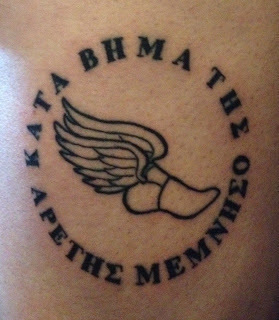
Of course, that one didn't quite make sense for a runner, so I showed him another from the same collection, κατα βημα της αρετης μεμνησο, or "With every step, remember [your] virtue." ("Virtue" is not a perfect translation; you could translate it as "excellence" also.)
Three years have passed since that conversation with Brian, but a few months ago he tracked me down and showed me his tattoo, which I rather like:
In a new twist, last year another student asked me to help him find the Greek verb "give thanks" as it appears in I Thessalonians 5.18. He didn't tell me what he planned to do with it, but when I saw him later that year at a wedding he showed me this, which he has tattooed on his wrist:
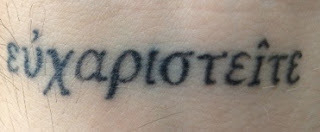
The word you see is ευχαριστειτε, related to our word "Eucharist" and the modern Greek ευχαριστω, meaning "I thank you."
I say this is a "new twist" because at least one passage in the Hebrew scriptures (Leviticus 19.28) appears to prohibit tattooing one's skin. Getting a tattoo, and in particular getting a tattoo of scripture, offers a bit of insight into one's hermeneutics. If the Gospels prohibited tattoos, I doubt many Christians would get them, but since the prohibition comes in the Hebrew scriptures, and since it seems to be tied to particular practices of worship or enslavement that no longer seem relevant, many young Christians are untroubled by it.
Recently one of my advisees showed me one of several tattoos she has recently acquired. This one is a longer Biblical text, from the prophet Micah, chapter 6, verse 8. I thought it interesting that she chose to get the Septuagint Greek rather than the Hebrew. She knows and translates Biblical (Koine) Greek and so I suppose she felt closer to that language. The text below means "...to do justice and to love mercy and to be ready/zealous to walk humbly with the Lord your God."
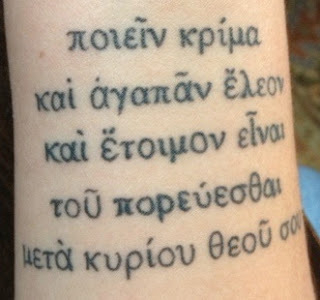
I like that verse quite a lot. If you don't know it, it begins by saying that this is what God asks of people. It's the sort of description that makes religion sound less like a burden and more like a description of a life well-lived.
I'm always reluctant to give advice about tattoos, because they're so permanent and so personal. And when I do give advice, I always want to write footnotes about regional dialects and historical and textual variants, or about the difficulties of translation. Quotes out of their native context so often seem lonely to me - such is my academic habit, of always seeing texts as living and moving and having their being* in nests and webs of other texts. Perhaps that's why I've never been inked myself, and I doubt I ever will get a "tat." I'm just not confident I've found words or an image that I'd want written on me forever. Sometimes that feels virtuous because it's prudent; other times I wonder if that's not a moral failing on my part, like I should be willing to commit to something. But I think for now I will remain uninked, and will continue to admire the commitments of my students.
* For example: I am borrowing this phrase ("live and move and have their being") from St Paul in Acts 17.28; he, in turn, appears to be borrowing it from Epimenides, who writes Εν αυτω γαρ ζωμεν και κινουμεθα και εσμεν. The phrase winds up being used in a number of other places, having been so eloquently translated into English by the King James Version of the Bible. See, for example, its use in the Book of Common Prayer, and in the first line of the hymn "We Come O Christ To Thee."
A few years ago a student named Brian came to me and asked "How do you say 'Suck Less' in Greek?" Apparently this was a phrase that his running coach said to his team to inspire them to run better.
As crude as the phrase is, I was intrigued by the problem of translation. "In order to translate the phrase I'd have to know what you mean by it," I replied. I spent a little while explaining how it would be possible to say, for instance, that an infant should nurse less; or that one should inhale less strongly. Or, if you pursue the more colloquial usage of the verb "suck," you might decide that it refers to poor behavior or - ahem - to a kind of erotic pleasure-giving in which the giver is thought to be demeaned by the giving.
Eventually I made the case that if you want to say it in Classical Greek, it would make sense to say it in a way that attended to the use of words in that language, and pointed him to Plutarch's Sayings of Spartan Women as a source of pithy sayings about living and acting strenuously. Ever since I took my first Greek class with Eve Adler at Middlebury College years ago, I've liked the phrase η ταν η επι τας, (at the link above, see #16 under "Other Spartan Women"; click on the Greek flag to see the full Greek text) which is often translated "Come back with your shield or upon it," meaning "Act virtuously in battle; either die with your weapons or win with your weapons, but do not throw them away in order to win your life at the expense of your virtue." I like the Greek phrase for its Laconian pithiness.
Of course, that one didn't quite make sense for a runner, so I showed him another from the same collection, κατα βημα της αρετης μεμνησο, or "With every step, remember [your] virtue." ("Virtue" is not a perfect translation; you could translate it as "excellence" also.)
Three years have passed since that conversation with Brian, but a few months ago he tracked me down and showed me his tattoo, which I rather like:

In a new twist, last year another student asked me to help him find the Greek verb "give thanks" as it appears in I Thessalonians 5.18. He didn't tell me what he planned to do with it, but when I saw him later that year at a wedding he showed me this, which he has tattooed on his wrist:

The word you see is ευχαριστειτε, related to our word "Eucharist" and the modern Greek ευχαριστω, meaning "I thank you."
I say this is a "new twist" because at least one passage in the Hebrew scriptures (Leviticus 19.28) appears to prohibit tattooing one's skin. Getting a tattoo, and in particular getting a tattoo of scripture, offers a bit of insight into one's hermeneutics. If the Gospels prohibited tattoos, I doubt many Christians would get them, but since the prohibition comes in the Hebrew scriptures, and since it seems to be tied to particular practices of worship or enslavement that no longer seem relevant, many young Christians are untroubled by it.
Recently one of my advisees showed me one of several tattoos she has recently acquired. This one is a longer Biblical text, from the prophet Micah, chapter 6, verse 8. I thought it interesting that she chose to get the Septuagint Greek rather than the Hebrew. She knows and translates Biblical (Koine) Greek and so I suppose she felt closer to that language. The text below means "...to do justice and to love mercy and to be ready/zealous to walk humbly with the Lord your God."

I like that verse quite a lot. If you don't know it, it begins by saying that this is what God asks of people. It's the sort of description that makes religion sound less like a burden and more like a description of a life well-lived.
I'm always reluctant to give advice about tattoos, because they're so permanent and so personal. And when I do give advice, I always want to write footnotes about regional dialects and historical and textual variants, or about the difficulties of translation. Quotes out of their native context so often seem lonely to me - such is my academic habit, of always seeing texts as living and moving and having their being* in nests and webs of other texts. Perhaps that's why I've never been inked myself, and I doubt I ever will get a "tat." I'm just not confident I've found words or an image that I'd want written on me forever. Sometimes that feels virtuous because it's prudent; other times I wonder if that's not a moral failing on my part, like I should be willing to commit to something. But I think for now I will remain uninked, and will continue to admire the commitments of my students.
*****
* For example: I am borrowing this phrase ("live and move and have their being") from St Paul in Acts 17.28; he, in turn, appears to be borrowing it from Epimenides, who writes Εν αυτω γαρ ζωμεν και κινουμεθα και εσμεν. The phrase winds up being used in a number of other places, having been so eloquently translated into English by the King James Version of the Bible. See, for example, its use in the Book of Common Prayer, and in the first line of the hymn "We Come O Christ To Thee."
*****
Update: a week or so after posting this I ran into the mother of one of the people whose tattoos are shown above. She thanked me, though I am not sure whether she was thanking me for helping her son get a tattoo, or for helping him to get the grammar right.
∞
Joy Run
Yesterday we ran for joy. About eighty people showed up to join me to run one-tenth of a marathon around the Augustana College campus.
It started as a response to the attack on the Boston Marathon last week. I decided to defy the preachers of fear by running for joy, and to honor those tens of thousands of runners who ran in Boston. And I invited friends, because joy shared is joy amplified.
I didn't expect many people to join me, so I was surprised to find seventy or eighty runners - and a few walkers, and quite a few dogs - waiting for me when I arrived. Even more surprising were the TV cameras from all the local stations, and the reporter from the Argus Leader. Here are some links to their stories: Argus, KDLT, KSFY. And, of course, at our Augie news website. I was pleased to talk with such intelligent and kind reporters who thought this was newsworthy.
I was so swamped by the interviews before the race that I wasn't able to snap a photo of everyone beforehand, but here's a photo of some of the people who ran with me, at the finish line. I'm grateful to live with such joyful people.
Several of those who ran with us also ran the Boston Marathon, including two who ran this year and two who ran in previous years. We were honored by their presence.
It's better to live lives of joy, lives of neighborly care, lives full of what St John calls agape, or nurturing love, than to live lives constricted by fear. My gratitude goes out to everyone who ran with me, and to the reporters who covered it, and to all people everywhere, who bring joy to the world.
It started as a response to the attack on the Boston Marathon last week. I decided to defy the preachers of fear by running for joy, and to honor those tens of thousands of runners who ran in Boston. And I invited friends, because joy shared is joy amplified.
I didn't expect many people to join me, so I was surprised to find seventy or eighty runners - and a few walkers, and quite a few dogs - waiting for me when I arrived. Even more surprising were the TV cameras from all the local stations, and the reporter from the Argus Leader. Here are some links to their stories: Argus, KDLT, KSFY. And, of course, at our Augie news website. I was pleased to talk with such intelligent and kind reporters who thought this was newsworthy.
 |
| Some of the Joy Runners |
Several of those who ran with us also ran the Boston Marathon, including two who ran this year and two who ran in previous years. We were honored by their presence.
It's better to live lives of joy, lives of neighborly care, lives full of what St John calls agape, or nurturing love, than to live lives constricted by fear. My gratitude goes out to everyone who ran with me, and to the reporters who covered it, and to all people everywhere, who bring joy to the world.
∞
Don't Worship The Monsters
On the God's Politics Blog at Sojourners, my latest attempt to answer the question of what to do when we are confronted with senseless violence. My answer: don't worship the monsters. An excerpt:
"Killing the bodies of our enemies does not make them disappear. We must also choose to forgive them, in a refusal to let their violence rule our hearts. The alternative is to cherish their violence, silently fondling it in our minds and enshrining it in policies founded on fear."Last Advent I tried to say something similar, in a poem.