Symbiosis, Timeframes, and Benefit
This morning I spoke to a nature writing class at Middlebury College. The class is about rivers, so I spoke to them about my own writing, and my work in mussel ecology.
Students had good questions, perhaps because they have a good professor, Matthew Dickerson, who has taken them on regular field trips to visit the rivers and streams around their college.
Some of the questions students asked:
- How did you get interested in freshwater mussels?
- What can be done to restore mussels when their habitat has been impaired or they have been extirpated?
- Mussels benefit from host fish. Do the fish get any benefit from mussels?
I want to dwell on that last question for a moment:
Biology textbooks generally talk about symbiosis as being mutualistic (both species benefit), commensalist (one species benefits, one suffers no harm), or parasitic (one species benefits, one suffers harm).
There’s more to it than that, but that’s a big-picture overview: when we talk about symbiosis we want to know whether there is competition for resources (including the lives of the organisms involved), and which organisms gain benefits.
It’s a useful way to discuss the interaction between individuals in the short term.
Another way of looking at it is to think about the effects on populations and on ecosystems over a longer period of time. In other words, we can shift what we mean by “benefit” and examine it over the long run.
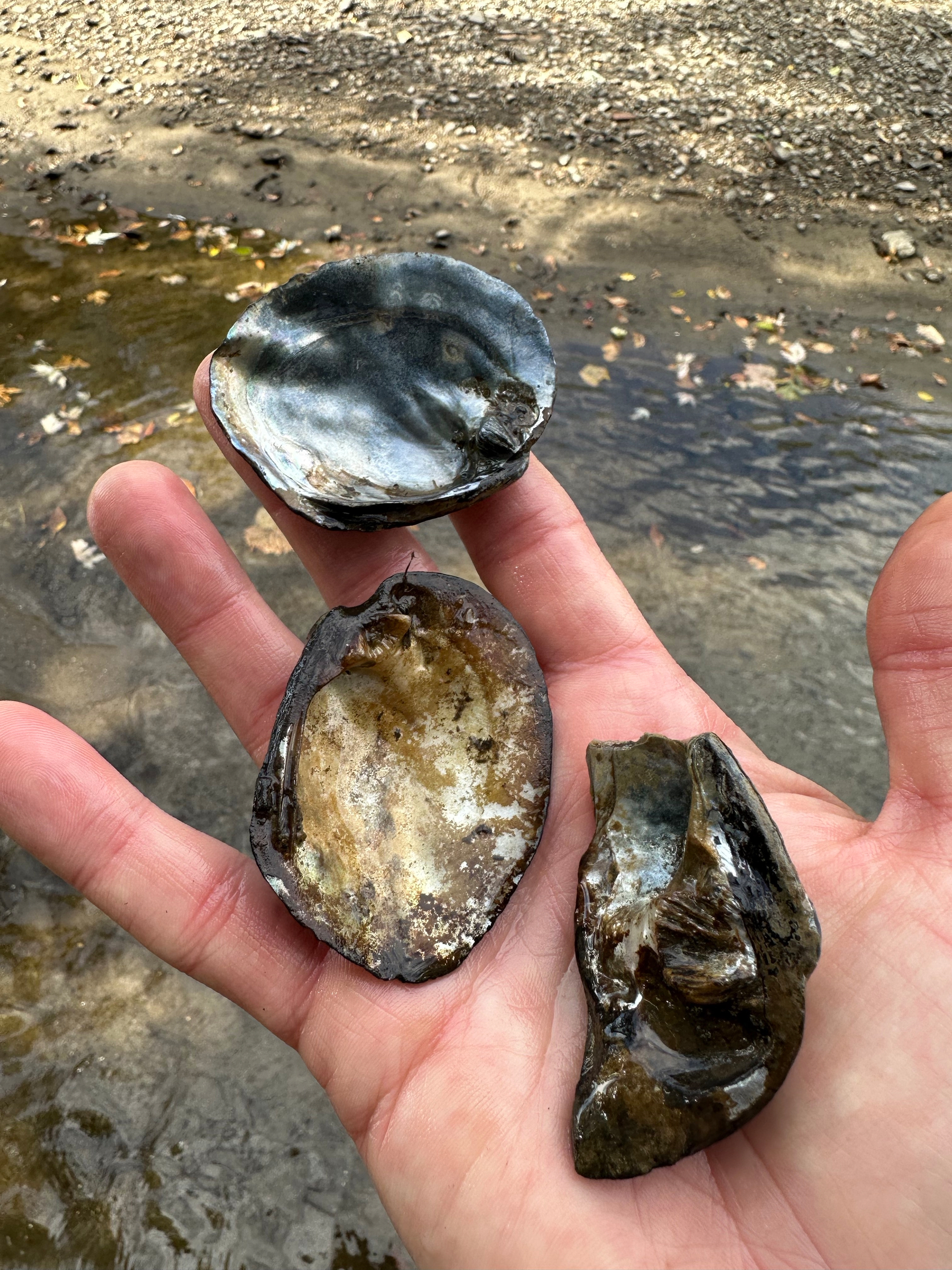
Most of the 300 or so species of freshwater mussels native to North America (mostly Unionidae species) have obligate relationships with host fish (or salamanders). A gravid female mussel mimics something fish eat, and when the fish bite, the young mussels (glochidia) are released into the fish’s mouth where they clamp down on the gills and other tissue, catching a free ride to their next home.
For a while, they live inside the fish, protected from predation and kept in the clean water that both fish and mussels need to survive. Eventually, they let go of the fish and find new homes in the river bottom, where they will likely stay for the remainder of their lives.
While the glochidia are attached to the fish, the fish has an immune response to the glochidia that eventually can protect the fish from future parasitism. If it sounds unattractive to have something live safely inside your lungs until it finds a new home, that might be how the fish feel, too.
So we could classify the mussels as obligate parasites. Obligate because they need the fish as both midwives and nurseries for their young, and parasites because the mussels benefit while the fish do not.
But if we expand the timeframe and the notion of benefit, we see a different picture. Mature mussels are filter feeders that can filter gallons of water a day. In a river or lake with a healthy mussel population, the water is cleaner, which makes it easier for the fish to breathe, and for the sunlight to reach further into the water, stimulating growth at a range of depths.
While the individual fish that plays host to the glochidia might be mildly harmed, without the mussels that already exist, that fish might not survive. And the fish’s descendants, perhaps many generations in the future, will benefit from the mussels that their ancestor carried at some personal cost.
In simpler terms: the grandparent might pay a price of hosting mussels in order for their grandchildren to live in a healthy environment. The hosting is a cost, but the thriving of the grandchildren is a benefit. It all depends on whether we are looking at the individual or the population, and whether we are thinking in the short term or the long term.
Of course there are other factors, and not all mussels, not all fish, and not all waterbodies are the same. But hopefully this one oversimplification serves as a counterbalance to another oversimplification in which we think only about short-term benefits for individuals.
I’ll end with a regret: I didn’t get around to talking about the importance of sketching what you see. I even had my sketchbooks and some excellent nature journaling books by my teachers John Muir Laws and Robin Lee Carlson on the desk beside me. But the conversation flowed in a different direction, so we never wound up touching on art. Oh, well. Next time, maybe.