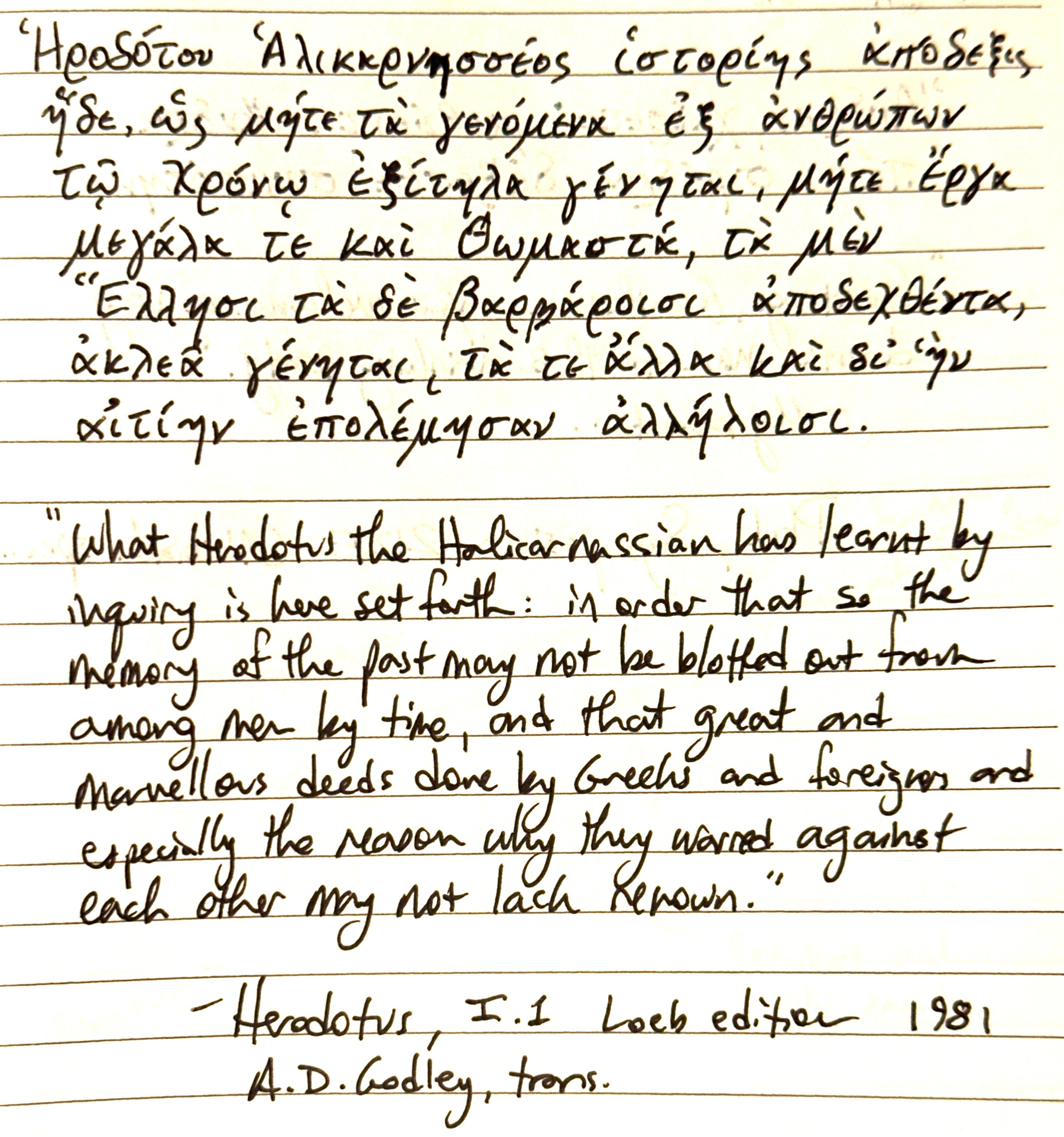
Herodotus in my Pocketbook
I carry notebooks with me everywhere.
Sometimes they’re for new thoughts.
Often they’re for very old ones.
I was recently in our university library (use it or lose it!) spending time with some of the Greek classics of historiography. I probably pulled forty books from the shelves, most of them in Greek, most of them too expensive for me to own copies of, most of them rarely visited and quite hard to find online or in digital form.
And I took notes. I had my laptop, so I typed some notes. I also took notes with pen and ink, a stable and durable form of note-taking. One that allows me to sketch, and that makes it easy to switch between languages.
Here’s one classic piece I jotted down. Not because I needed to, but because I could, and because the slow process of jotting notes lets the words seep into my muscles and neurons, lets them become a part of my being.
“Have you pen and ink, Master Doctor?”
“A scholar is never without them, your Majesty,” answered Doctor Cornelius.
– C.S. Lewis, Prince Caspian, ch. 13