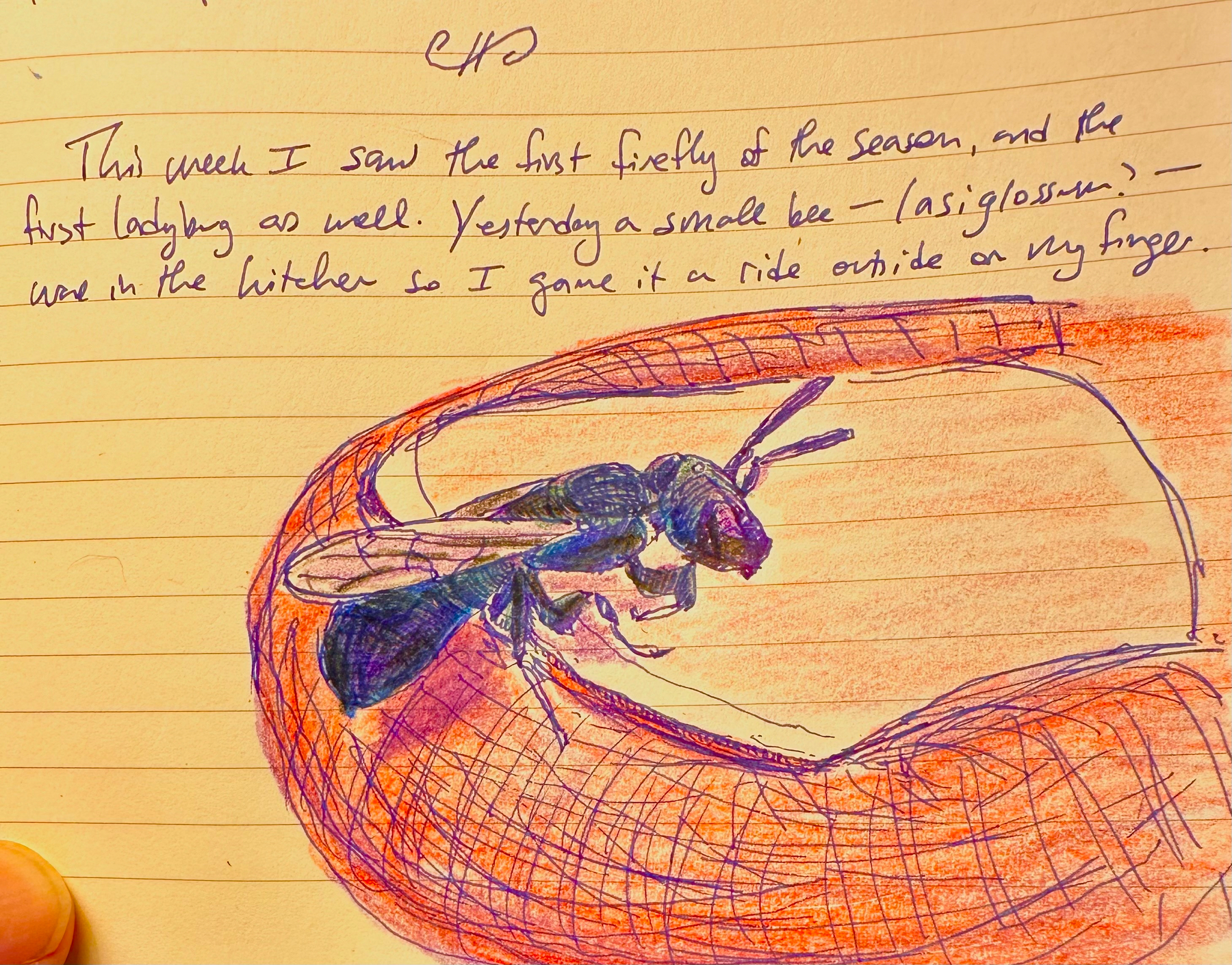
Bee Phenomenology With Pencils
The point is not to get a photo-perfect sketch of the bee on my finger. The point is to see the bee better, to get to know the bee and its relationship to the world. To see the curvature of each leg, and to wonder how they help her to cling to flowers, to find food, to build a nest. To observe the venation of the wing, and to notice how an insect species’ wing veins are like our fingerprints: so similar and yet the small differences make all the difference in species identification. Why is that? (And why are my fingerprints so hard for me to draw?) How do slight differences in the veins affect flight, and wing strength? Sketching with a pencil gives the questions time to arrive, first a few, then a swarm. Why are some antennae long and some short? Why do different species of bees (4000 species in my country alone, 25000 worldwide) have different lengths of “cheek”? How do those small eyes on top of the head relate to the two big eyes? What is bee consciousness like? Why was this one so willing to let me bring my finger near her to give her a ride out of the kitchen and back into the great outdoors? Did she see me and recognize me as another animal? Or did she only see my finger, feel its warmth and its saltiness?
Some years ago I attended a conference on phenomenology. I spoke about invertebrates I had been observing. Afterwards someone came up to me and said everyone here is talking about phenomenology but you seem to be the only one doing it! I’m not sure that’s true, but I do think the pencils and pens change the way I think about phenomenology, and the way I practice it.