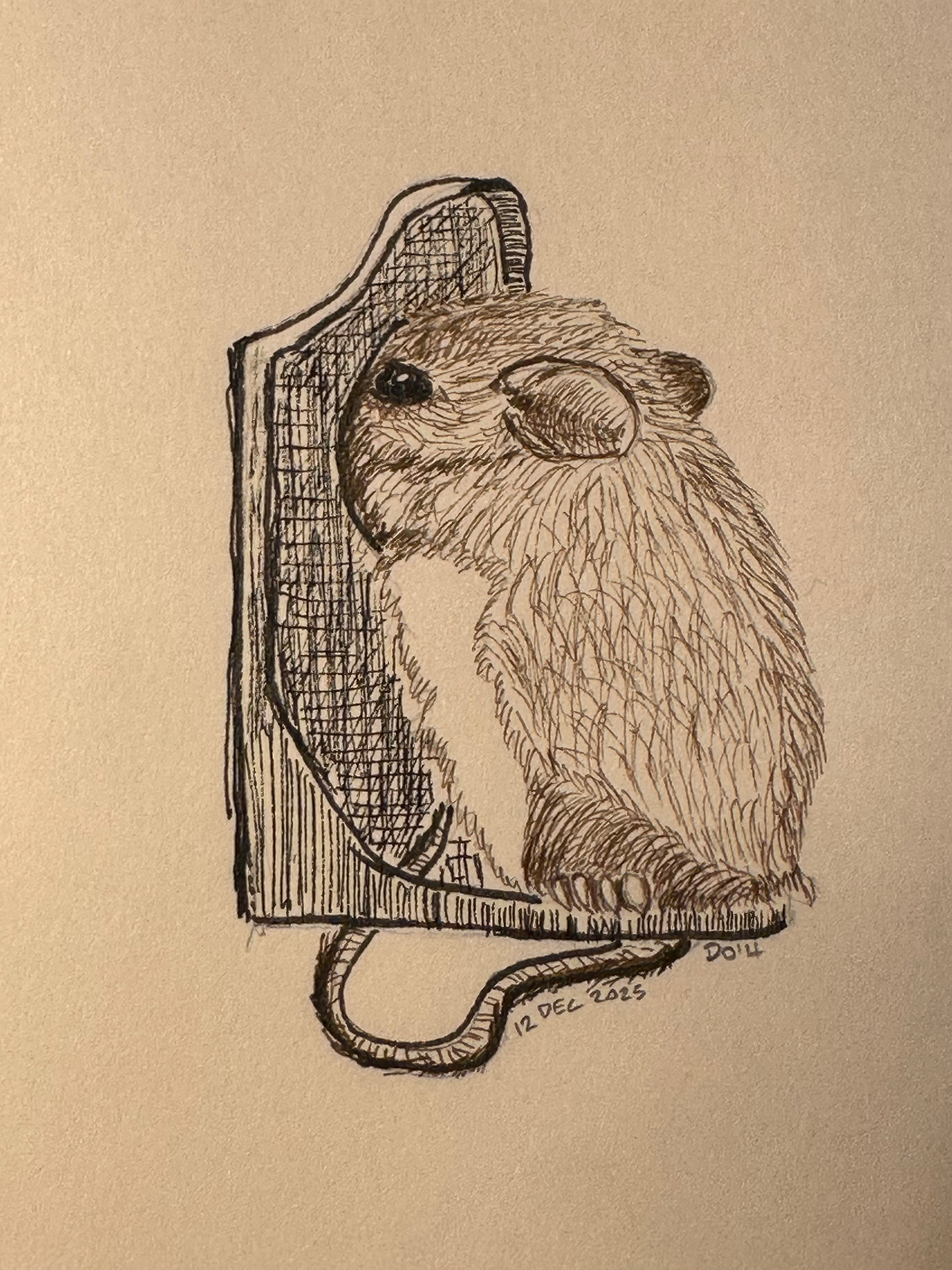
Today’s entry in the book I am writing for my granddaughter includes a sketch of one of the mice I saw at the birdfeeder. It’s cold out there! I hope the mice tucked away a good meal.
Celestial Observations
From a student report, in a class where I require them to do astronomical observations:
“I used to hate god, but looking at the stars has changed how I view ‘god.’ I looked up and saw something new. God is love.”
This is unprompted. The assignment was not about religion.
But I love seeing what they learn.
Another wrote:
“I learned so much more than I expected to learn. I learned about the motion of the sun, but I also learned about the spirit of the readings in the class.”
The class, by the way, is ancient and medieval philosophy. I want them to consider the skies as the ancients like Thales once did, without telescopes, but maybe with a mug of hot cocoa and a friend to chat with.
We often drive together to the Badlands National Park and watch the Orionid meteor shower, and a handful of us did that this October.
But no matter where they are, when the look up, they often see more than the stars.
I regret updating to IOS 26.1. I think Apple meant well but my screen is so much busier now, and the buttons that were familiar and helpful are now just a little harder to find.
Someone please tell me how cool the new IOS is. I must be missing something.
Socrates annoys even modern students, by refusing to tell us what justice is.
Instead, he asks questions to help us examine justice and the good life.
And so often we miss the point that justice is not a fact to be defined for a quiz, but an excellence to be pursued throughout our life together.
At the end of our exam yesterday my students applauded my course in ancient and medieval philosophy. I don’t recall that ever happening before.
Unvisited Tombs
In my last year of college I signed up for a course on the early English novel. In the first week the professor assigned George Eliot’s Middlemarch.
I had enjoyed reading long novels on my own, but when assigned an eight hundred page novel and given three days to read it, I quickly decided I had better things to do with my life.
I was already in a class on Cervantes (reading his original Spanish) and another class on medieval Spanish literature (often hundreds of pages of reading a day in that one) so I backed out and contented myself with a history class instead.
Some books are made for fast reading. Texts on biology and ecology I breeze through with exhilaration. When I read new research on malacology, I want to absorb it all quickly and then get out into the field as soon as possible.
Others are books I like to work through, like texts on mathematics. Some proofs are delights that need to be savored. Problem sets are, generally speaking, a gift, and a way of learning by playing.
Poems (especially short ones) and good novels are like landscapes. I don’t want to snap a quick photo and move on; I’d rather spend time wandering, seeing what grows there, feeling the ground under my feet.
So this year, a few (!) years after my senior year of college, I have returned to Middlemarch. And I’m so glad I am doing so when I have time to read it slowly. One chapter on Dr. Lydgate is full of criticism of higher education and of the pharmaceutical industry that still feels relevant today. Throughout, reflections on sainthood and on the individual lives of insignificant people in a small town (who’s to say these are not the same thing in any particular case?) are constant reminders of the hidden inner lives of the people next door.
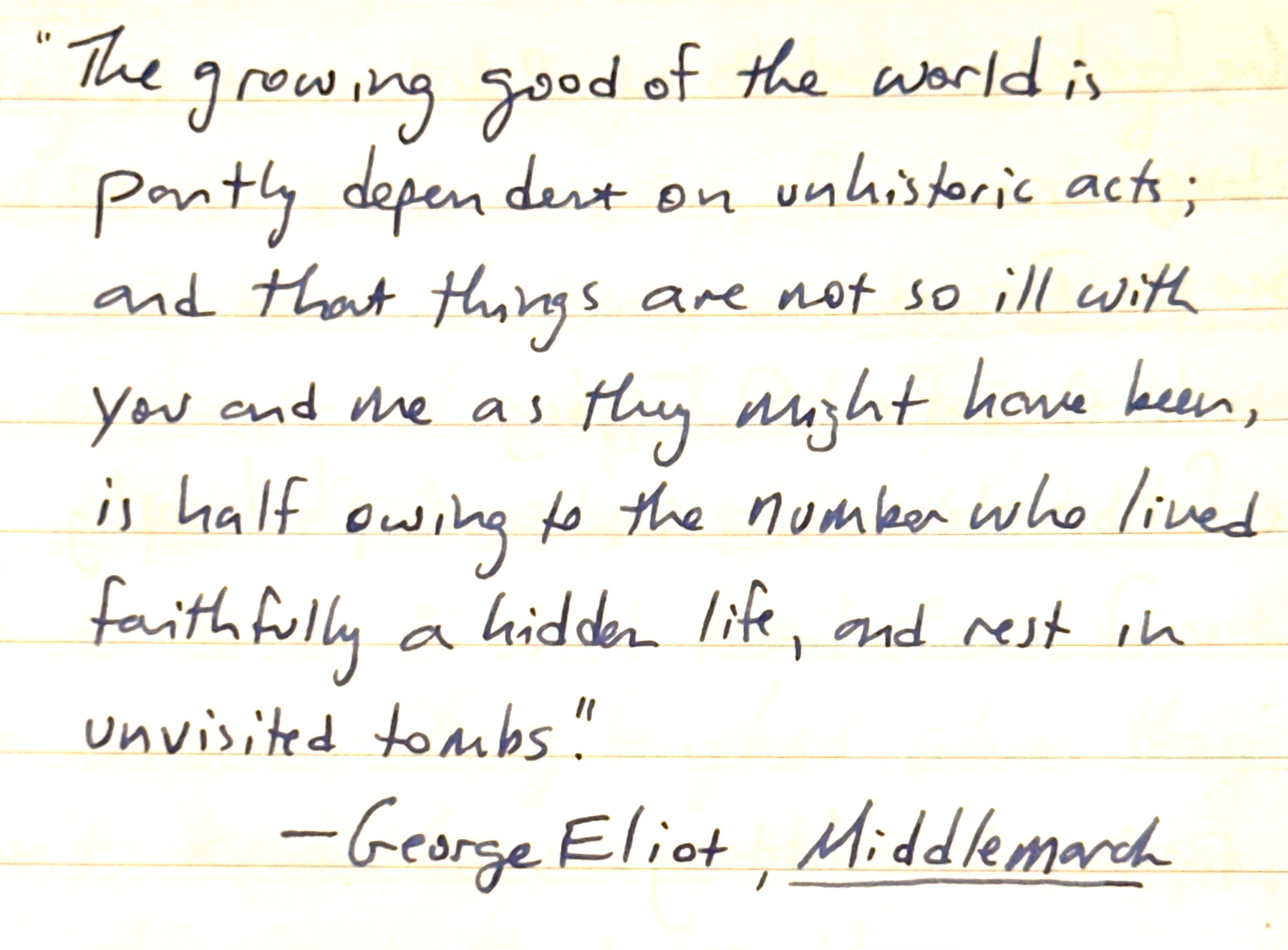
And of course there is that passage I have often returned to, the reminder that the goodness of my life and of yours are both dependent on the many people who made small decisions that now affect us.
Some of them “lived faithfully a hidden life,” and we will never know their names, but our lives are now better because of them.
It’s tempting to play the lottery, to start the Next Big Thing, to earn a Name for oneself, to make a splash and be remembered for it.
Most of us, however, won’t have our names on great buildings. Most of us won’t make the history books. Most of us won’t win medals of honor, or have our deeds engraved on great stones for all the ages to see.
But that should not prevent us from living faithfully, even if our lives are hidden. Even if (perhaps especially if) we never become known as “influencers” or bestselling authors.
Our only reward might be long rest in a tomb that is untroubled by visitors.
When I am dead, I might not care. But the thought of living now in such a way that others might someday benefit from it makes the small things feel like acts of love, like planting the seeds of trees that will outlast me, and give fruit and shade to others who need them someday.
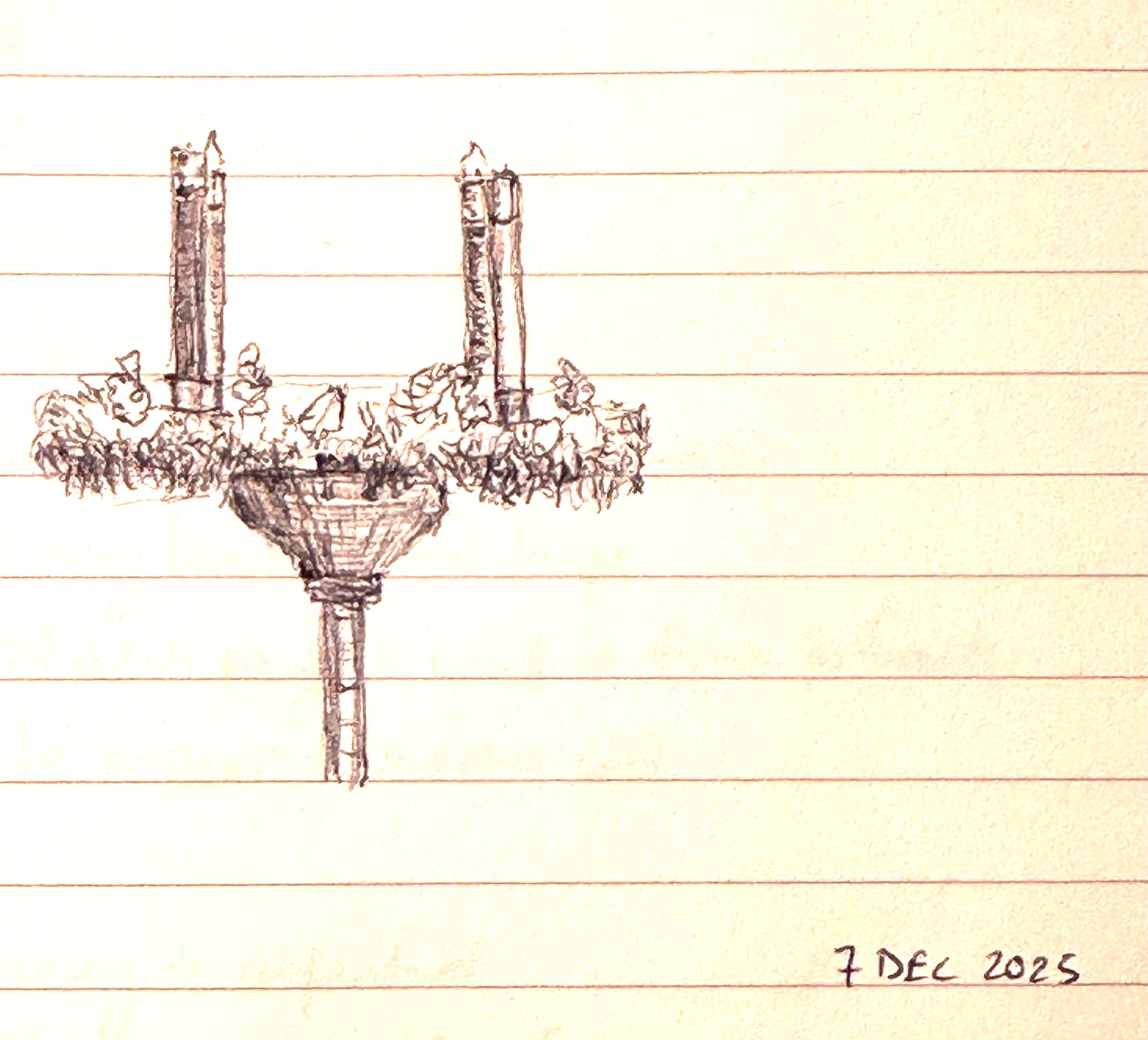
Peace Candle.
A meditation with ballpoint pen and pocket notebook before church began on Sunday, the second Sunday in Advent.
You’ve Got Mail
In class yesterday I told my students that I’ll pay the postage to mail a copy of their final reflections on “how to live well” to them in a year. I think they’ll enjoy re-reading what they wrote, and it will give them a chance to reflect on what progress they’ve made in a year.
I brought envelopes to class and asked students to write their mailing address on the envelopes.
It was a funny moment when we realized that their generation doesn’t really send mail.
A few of them sheepishly asked me to remind them how exactly to format their address on an envelope. They all learned it at some point, but generally enter their address into online forms that take care of the details.
We all laughed, and I heard some of them saying to friends “I can also write in cursive!” They’re “digital natives,” as they say.
Each year fewer students carry paper and pen with them. A few years ago my university replaced its bookstore with a swag store. That still feels like a loss to me, but my students are accustomed to carrying all their books on a digital reader.
I’ve really enjoyed this group of students, and their reflections and conversation about great texts this semester have reminded me why I do this work. I’m going to miss them all.
But I’ll put my return address on the envelopes I send. Who knows? Maybe one or two will send a reply.
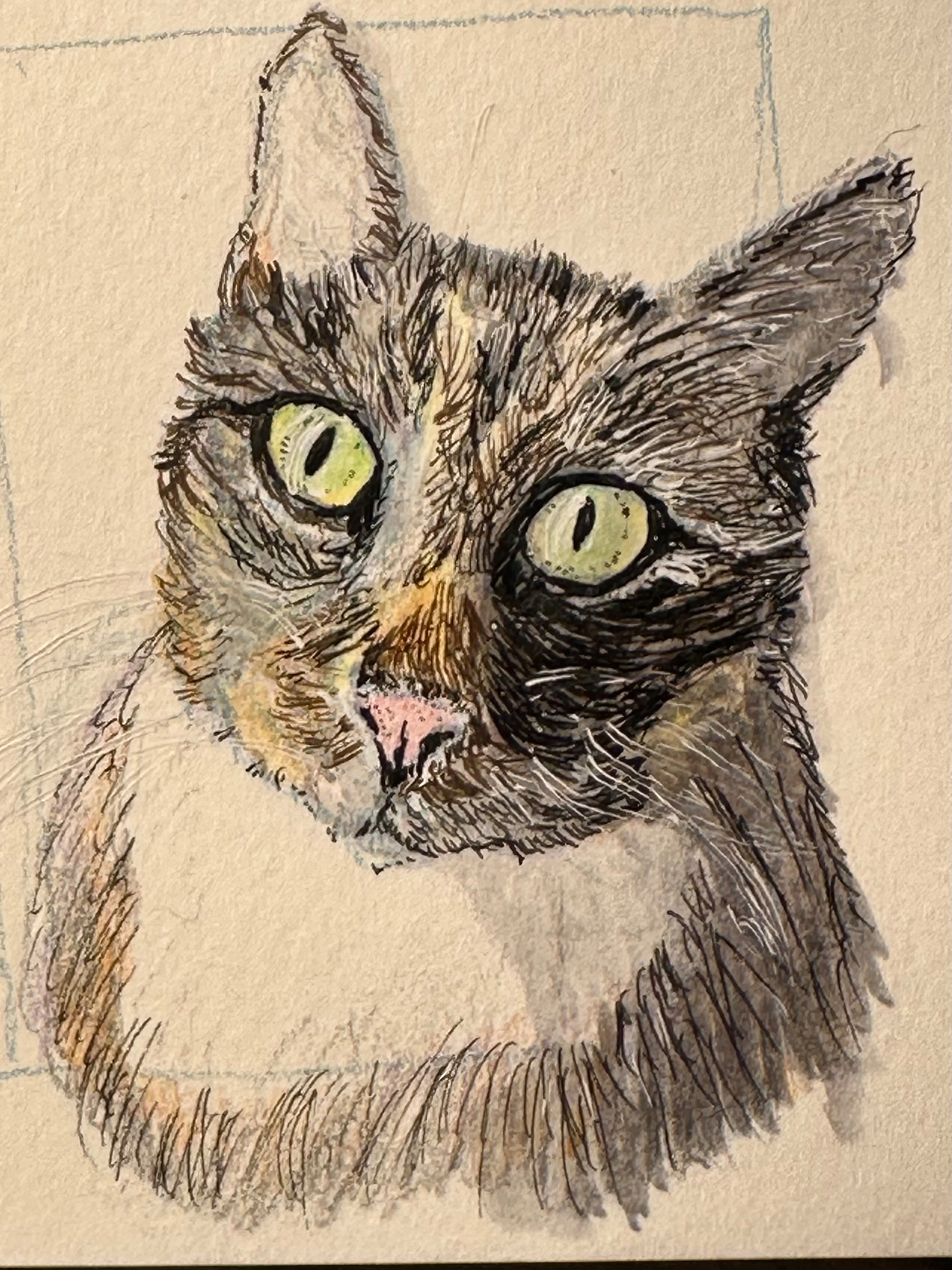
One of the family cats. A quick sketch in between grading philosophy papers.
Gardening What We Believe
A student in my How To Live Well (Intro to Philosophy) class commented on his final reflection that his beliefs did not change throughout the semester. He did examine them for the first time, he said, and he enjoyed that opportunity, especially since he did so alongside of several classic texts. But he was a little surprised that his beliefs did not change.
I replied to him:
“Great! Sometimes we find that we should change our beliefs, but in general I think our beliefs are like plants in our gardens: a few might be weeds; a few might have grown too big, and need to be pruned back; a few might need to be fertillized, watered, and given better growing conditions. And sometimes we find we want to sow some new seeds, or move plants around a bit to achieve a better arrangement.”
This is his first semester of university, and his first encounter with texts like Plato’s Republic and Augustine’s Confessions. My hunch is that those texts have done a little tilling and pruning, and maybe some new seeds have been planted. Or maybe he just got to see how some other people have gardened their beliefs, giving him some new ideas for how he will cultivate his own garden.
Tomorrow we will have our final class discussion, and I’ve already told the students that the topic is this: now that we have spent a semester considering how we might live well, what do others need from us as they seek to live well also?
And behind that question is another hunch of mine, one that is partly grounded in Plato, Augustine, and many others who had ideas and then wrote them down for others to consider: as Robin Wall Kimmerer and Kathleen Dean Moore have both written in several places: All flourishing is mutual.
Wrestling
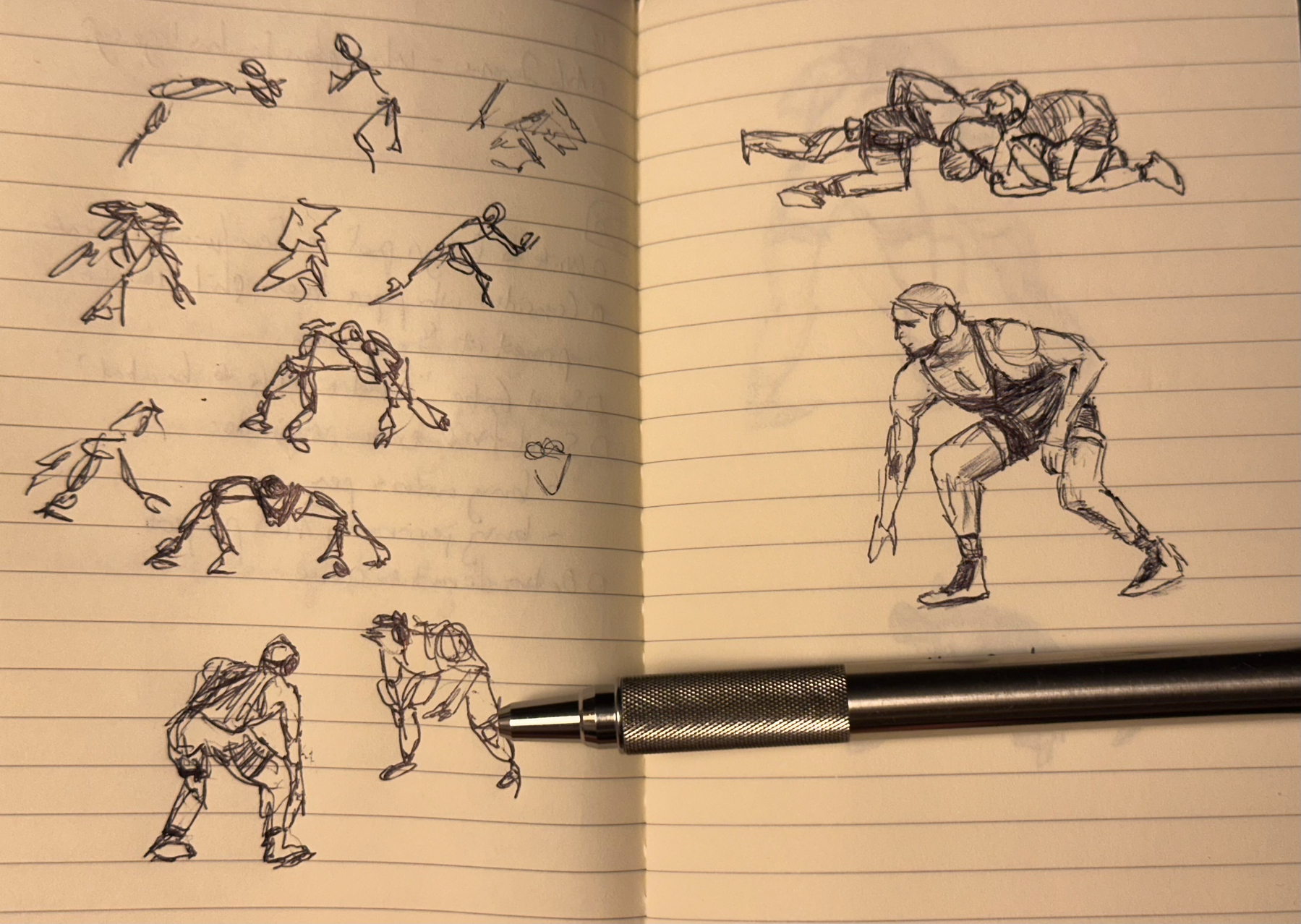
Some quick sketches in my pocket notebook from yesterday’s wrestling meet at my university.
Some of these wrestlers study philosophy and environment with me, and they’re as agile of mind as they are on the wrestling mats. Such a delight to watch them use their gifts.
Thucydides on Justice and War
“For ourselves, we shall not trouble you with specious pretenses—either of how we have a right to our empire because we overthrew the Mede, or are now attacking you because of wrong you have done us—and make a long speech which would not be believed; and in return we hope that you, instead of thinking to influence us by saying that you did not join the Spartans, although their colonists, or that you have done us no wrong, will aim at what is feasible, holding in view the real sentiments of us both; since you know as well as we do that right, as the world goes, is only in question between equals in power, while the strong do what they can and the weak suffer what they must.”
– The Athenians in the “Melian Dialogue” in Thucydides 5.89 (from Robert Strassler’s The Landmark Thucydides, an edition I highly recommend.)
Lots of ink has been spilled over this event and over this passage. That last line continues to hit hard:
“the strong do what they can and the weak suffer what they must”
The same idea has been repeated again and again. Thucydides knew it was important to write it down 25 centuries ago, as he knew that the Pelopponesian War was a war full of lessons. So he wrote its history as a ktema es aei, a heritage unto the ages.
And when we read it today, we are struck by the fact that a war that took place so long ago and (for most of us) so far away still sounds like it was full of very human words, and very human acts.
These words are on my mind today as my nation makes sundry choices about where and whether and how to become involved in conflicts around the world. Too often we say things like “the strong do what they can and the weak suffer what they must” because it makes a kind of sense.
The question is: does it make the best kind of sense, or merely a convenient and lesser kind?
“Observe your laws, through which especially you have become great.”
– Euryptolemus, in Xenophon’s Hellenika, 1.7.29
“Kallikratidas, annoyed by the delay and angered by his unsuccessful visits to Cyrus, said that the Greeks were most wretched, since they flattered barbarians for the sake of money.”
– Xenophon, Hellenika, 1.6.7
Scholarship and a Love of Nature
Reading Andrew Ziminski’s words about the Celts of Cornwall, Wales, and Ireland, and their “thin places” where monastic culture thrived and was “known for a religious ideal based around a life of poverty and simplicity, scholarship and a love of nature.” This sounds like my own life and values, and it makes me wonder how much of that I have inherited, passed down in unspoken ways from my Celtic family.
Reflecting on Values
This week I’m reading the final reflections for my intro to philosophy class. I asked students to reflect on their values, where they come from, and what values they hope to cultivate.
Most of my students are saying no one has ever asked them to consider their values before.
And most of them seem to appreciate the opportunity to do so.
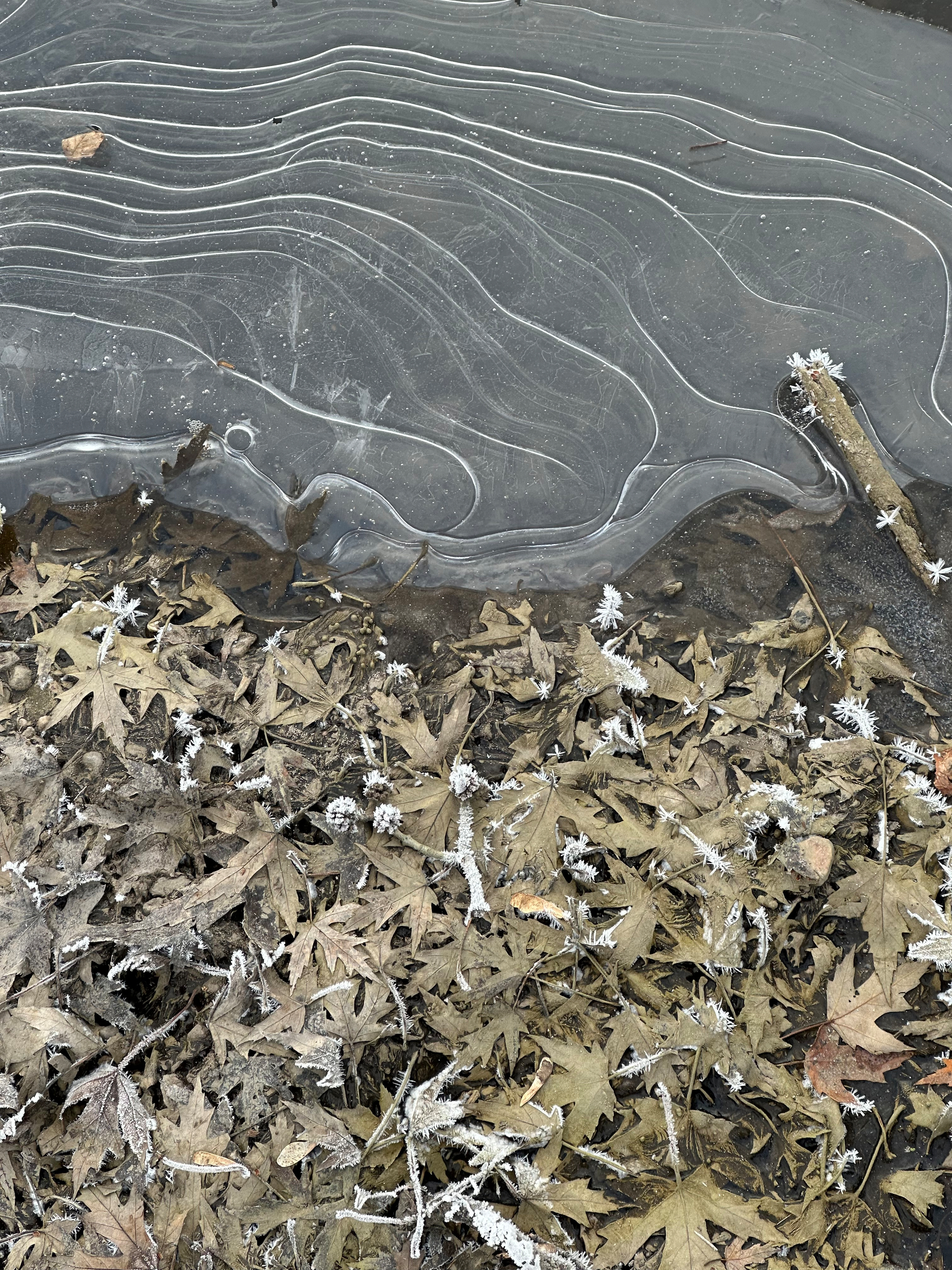
Season
Plans
Today I resolve to be as ruthful, gruntled, and chalant as possible.
Possibly also kempt and shevelled, but don’t hold your breath on those. I’m rating those as highly unlikely.
Being plussed is an aspiration. Obviously the dual (and contradictory) meanings of “nonplussed” could work to my advantage here.
Eptitude is (at best) an aspiration, but likely beyond my reach. Probably depends on how defatigable I am today.
“The story, not information, is what we inhabit.”
Alison Hawthorne Deming, Writing the Sacred Into the Real
Own Your Attention
“Experts are trying to commodify your attention. Sketching is a revolutionary act [of owning your own attention].”
– John Muir Laws, at a nature journaling class I took with him this summer
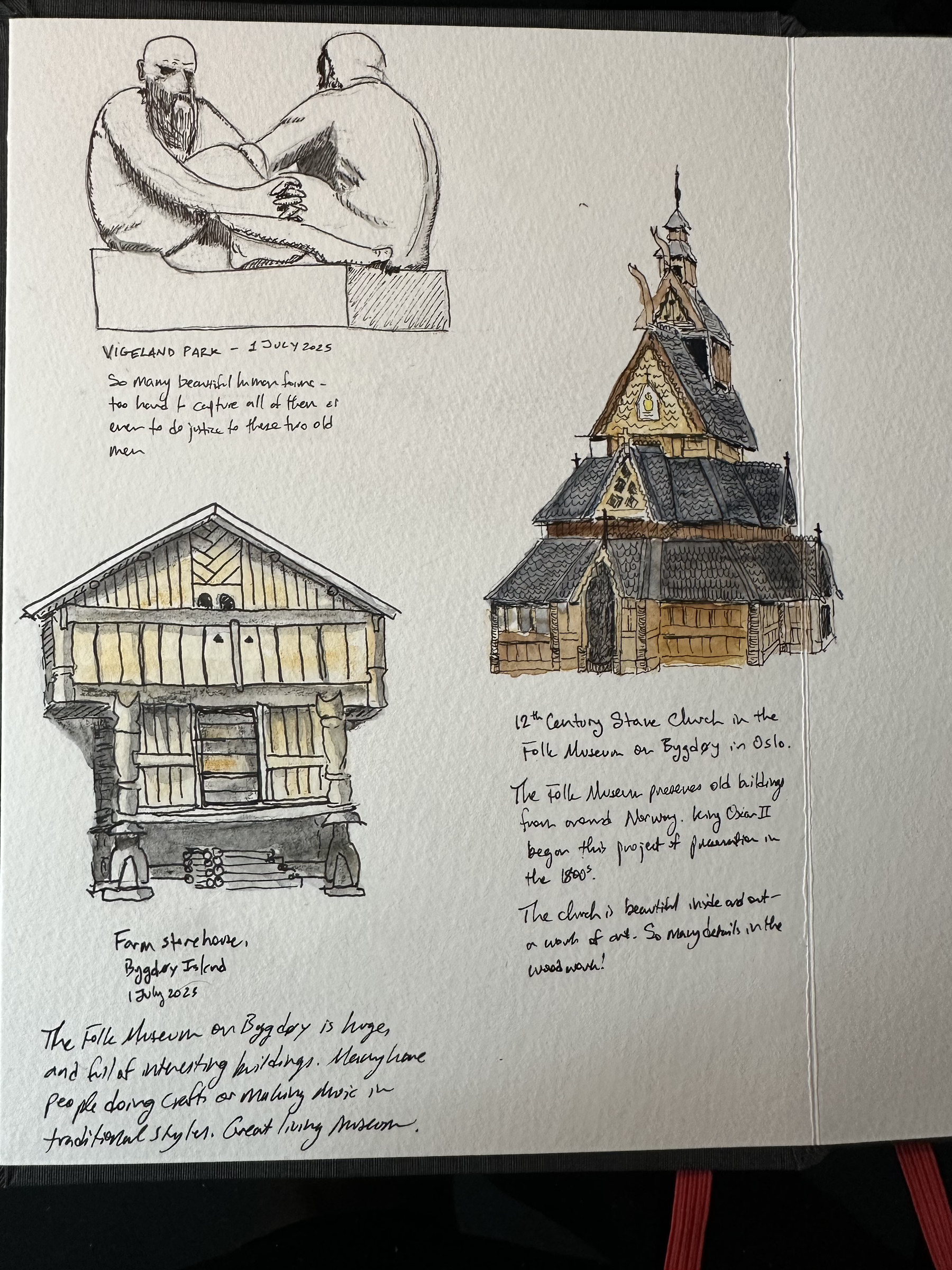
Image: a page from my sketchbook this summer while I was in Oslo. IOW, an image of me owning my own attention.