
∞
Run For Joy
As I mentioned in a recent blog post, and as the Sioux Falls Argus Leader has reported, I am going for a run for the sake of joy this weekend, and you're invited to join me, here or wherever you are.
The prophets knew this thousands of years ago: we become like what we worship. We might think we don't worship, but I'm here to tell you that the way you spend your life is the way you worship. We all worship. Each of us ascribes worth to things by giving our time, our money, and our attention to them.
It's tempting to give our attention to monsters, to worship the devils that the news cameras follow breathlessly through the streets. It is tempting to worship our fears, to let the things that could steal, or maim, or kill become the focus of our attention. It is tempting to hold the horrors in our hearts until we form them into perfect idols. If that weren't tempting, the news would look very different.
Avoiding idolatry - by which I mean worshiping things that are not worthy of our precious lives and attention - takes a conscious and sustained effort.
It requires us to remember not the horror but the joy. It requires us to give up the cramped life of fear and to stretch ourselves in the exuberance of being alive, of having a body.
At their best, this is what marathons are about: exultation in the gift of living an embodied life.
So run with me. Shake off the terrors, and feel your muscles, your bones, your sinewed vitality. Wherever you are, get out there and feel a little of what the marathoners were feeling as they ran, the hard-earned joy of running, the joy of feeling alive with other people.
Let me add that I'm not an accomplished runner, so don't expect me to lead the pack. This will be a run, not a race. If you want to walk with us, push a stroller, or whatever lets you feel the joy of being alive, come and join us. Bring your joy.
The prophets knew this thousands of years ago: we become like what we worship. We might think we don't worship, but I'm here to tell you that the way you spend your life is the way you worship. We all worship. Each of us ascribes worth to things by giving our time, our money, and our attention to them.

It's tempting to give our attention to monsters, to worship the devils that the news cameras follow breathlessly through the streets. It is tempting to worship our fears, to let the things that could steal, or maim, or kill become the focus of our attention. It is tempting to hold the horrors in our hearts until we form them into perfect idols. If that weren't tempting, the news would look very different.
Avoiding idolatry - by which I mean worshiping things that are not worthy of our precious lives and attention - takes a conscious and sustained effort.
It requires us to remember not the horror but the joy. It requires us to give up the cramped life of fear and to stretch ourselves in the exuberance of being alive, of having a body.
At their best, this is what marathons are about: exultation in the gift of living an embodied life.
So run with me. Shake off the terrors, and feel your muscles, your bones, your sinewed vitality. Wherever you are, get out there and feel a little of what the marathoners were feeling as they ran, the hard-earned joy of running, the joy of feeling alive with other people.
*****
I'm not collecting money, but I encourage you also to give a donation to an organization of your choosing that cares for those who suffer. I'm going to give to the Red Cross and the United Way. Because I think that love for neighbor is a worthwhile thing to focus my attention on, and giving my money helps to focus my attention.
And while you're at it: turn off the news and think about this: what is bringing you joy today? How are you bringing joy to others today? As someone wise once said, "whatever is true,
whatever is noble, whatever is right, whatever is pure, whatever is
lovely, whatever is admirable—if anything is excellent or
praiseworthy—think about such things."
*****
Let me add that I'm not an accomplished runner, so don't expect me to lead the pack. This will be a run, not a race. If you want to walk with us, push a stroller, or whatever lets you feel the joy of being alive, come and join us. Bring your joy.
∞
I Am Afraid
I am afraid.
Not very afraid, just a little. Mostly, I am afraid of using my days poorly.
But I'm not really afraid of death. I'm not really afraid that my plane will fall from the sky, or that the economy will collapse. Close calls from asteroids and comets don't worry me even a little bit.
There are a lot of things I don't want to lose - my job, my health, and especially my friends and loved ones - but I don't see the point of spending a lot of time worrying about that, especially since losing them is inevitable.
In his Ethics, Aristotle reminds us that courage is not the absence of fear. (The absence of all fear is just another kind of foolishness.) Courage is being afraid of the right things. Like living badly, or bringing shame and dishonor to oneself, to one's family and friends, to one's nation.
So I admit it: I'm a little afraid of wasting the time I'm given, of not living a life of love, of failing to live joyfully. I'm a little afraid that today I'll squander time on things that don't matter while not giving myself to those I love. I'm afraid of worshiping things that don't deserve my worship.
Thankfully, I'm not in charge of all time. I'm only in charge of what I do right now. Which means I have something positive I can do with that little fear of mine: I can fight it by doing something that matters. Right now.
Not very afraid, just a little. Mostly, I am afraid of using my days poorly.
But I'm not really afraid of death. I'm not really afraid that my plane will fall from the sky, or that the economy will collapse. Close calls from asteroids and comets don't worry me even a little bit.
There are a lot of things I don't want to lose - my job, my health, and especially my friends and loved ones - but I don't see the point of spending a lot of time worrying about that, especially since losing them is inevitable.
In his Ethics, Aristotle reminds us that courage is not the absence of fear. (The absence of all fear is just another kind of foolishness.) Courage is being afraid of the right things. Like living badly, or bringing shame and dishonor to oneself, to one's family and friends, to one's nation.
So I admit it: I'm a little afraid of wasting the time I'm given, of not living a life of love, of failing to live joyfully. I'm a little afraid that today I'll squander time on things that don't matter while not giving myself to those I love. I'm afraid of worshiping things that don't deserve my worship.
Thankfully, I'm not in charge of all time. I'm only in charge of what I do right now. Which means I have something positive I can do with that little fear of mine: I can fight it by doing something that matters. Right now.
∞
Run For My Life
Yesterday I went for a run. I'm not much of a runner, but it seemed like a good response to the Boston Marathon.
The Boston Marathon is a huge gathering for the sake of doing something none of us needs to do. It's a race, and yeah, someone will be fastest, but everyone who finishes it wins. A Marathon is an exuberance.
When the bombs go off and the guns fire, we all duck for cover. And we know what happens next: first the media run the same film loops dubbed with the same breathless commentary. And then someone announces that we're taking new security measures.
I'm sure all that's good. We need media, and it's just prudent to take security measures.
But it's not enough. If our response to terrorism is to feel afraid, the terrorists have won.
Which is why I am going to respond with joy. And more exuberance.
So here is what I will do: this Sunday, I am going for a run - I'm calling it a Joy Run - and I'm inviting my friends to join me. We'll run 2.62 miles (a tenth of a marathon - I'm not a great runner, so don't ask for more) and I'm going to ask them all to make a donation to the Red Cross or the United Way or another organization that exists to promote the public good and cares for people who are suffering.
If you know me, you'll know where to find me. If not, rather than having you call me and ask if you can donate, let me just urge you to do the same thing wherever you are.
There will always be people who want to limit life, who say no to life, who mail suspicious packages and kill strangers. I feel sorry for them; may God bless them by helping them learn to say yes to life, love, and wisdom. Because they exist, we'll always need to be vigilant.
But because we exist, we should not forget to live. Brightly, joyfully, exuberantly.
And so, this Sunday, inspired by those who ran exuberantly in the Boston Marathon, my friends and I are going to run. For my life, and for theirs, and wishing life and joy to everyone, everywhere.
The Boston Marathon is a huge gathering for the sake of doing something none of us needs to do. It's a race, and yeah, someone will be fastest, but everyone who finishes it wins. A Marathon is an exuberance.
When the bombs go off and the guns fire, we all duck for cover. And we know what happens next: first the media run the same film loops dubbed with the same breathless commentary. And then someone announces that we're taking new security measures.
I'm sure all that's good. We need media, and it's just prudent to take security measures.
But it's not enough. If our response to terrorism is to feel afraid, the terrorists have won.
Which is why I am going to respond with joy. And more exuberance.
So here is what I will do: this Sunday, I am going for a run - I'm calling it a Joy Run - and I'm inviting my friends to join me. We'll run 2.62 miles (a tenth of a marathon - I'm not a great runner, so don't ask for more) and I'm going to ask them all to make a donation to the Red Cross or the United Way or another organization that exists to promote the public good and cares for people who are suffering.
If you know me, you'll know where to find me. If not, rather than having you call me and ask if you can donate, let me just urge you to do the same thing wherever you are.
There will always be people who want to limit life, who say no to life, who mail suspicious packages and kill strangers. I feel sorry for them; may God bless them by helping them learn to say yes to life, love, and wisdom. Because they exist, we'll always need to be vigilant.
But because we exist, we should not forget to live. Brightly, joyfully, exuberantly.
And so, this Sunday, inspired by those who ran exuberantly in the Boston Marathon, my friends and I are going to run. For my life, and for theirs, and wishing life and joy to everyone, everywhere.
∞
My Two-bit Prayers
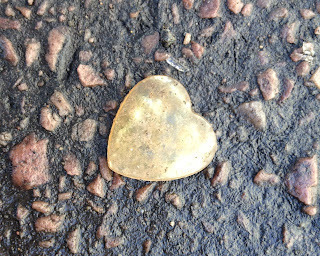
Today I sent a a picture of a quarter to my daughter's mobile phone.
Since she went off to college two years ago, I have saved for her every twenty-five cent piece that I've received in change.
With each one, I remember my daughter in prayer. The photo was a reminder: I am praying for you; I love you. Whenever I see her, I give her the pile of quarters I've accumulated, so that she can use them to pay for laundry.
My prayers for her are simple, just a quick remembrance of my golden, distant girl. Keep her in your hand, Lord. Help her to do good work today. Bless her studies. Bless her life. Bless her. Bless.
 A nun in Greece once told me that God does not need long prayers. God, she said, only wants from us what we are willing and able to give.
Praying prompted by coins is probably foolish, and silly. But it is what I have to offer, a simple trick I play, a daily reminder of love.
Prayer comes hard to me, harder than I would like to admit. I can't see this God to whom I wish to speak, so speech seems strange.
Just as I cannot see this girl--this woman--for whom I am praying. I can only hope that my unseen daughter is seen by my unseen God.
And so I hold my little coin and think of them both, committing this small amount of time, this small change, to each of them.
And I hope that my small offering might be made great, by slow accumulation, or by being magnified by the one who made us all.
Since she went off to college two years ago, I have saved for her every twenty-five cent piece that I've received in change.
With each one, I remember my daughter in prayer. The photo was a reminder: I am praying for you; I love you. Whenever I see her, I give her the pile of quarters I've accumulated, so that she can use them to pay for laundry.
My prayers for her are simple, just a quick remembrance of my golden, distant girl. Keep her in your hand, Lord. Help her to do good work today. Bless her studies. Bless her life. Bless her. Bless.
 A nun in Greece once told me that God does not need long prayers. God, she said, only wants from us what we are willing and able to give.
Praying prompted by coins is probably foolish, and silly. But it is what I have to offer, a simple trick I play, a daily reminder of love.
Prayer comes hard to me, harder than I would like to admit. I can't see this God to whom I wish to speak, so speech seems strange.
Just as I cannot see this girl--this woman--for whom I am praying. I can only hope that my unseen daughter is seen by my unseen God.
And so I hold my little coin and think of them both, committing this small amount of time, this small change, to each of them.
And I hope that my small offering might be made great, by slow accumulation, or by being magnified by the one who made us all.
∞
Scripture's Trajectory: You Are Known; Be Holy
Everybody interprets texts. Interpreting texts means, among other things, determining the trajectory of the texts. Where are they coming from, and where do they point us?
When it comes to the Bible, we've all been shaped by it, and we all have ways of responding to the pressures it has exerted while shaping us.
The early creeds try to maintain considerable latitude for how we regard the scriptures. For instance, the Nicene Creed says "We believe in the Holy Spirit...who has spoken through the prophets." Just how has the Spirit spoken, and what are we to make of that?
I'm grateful for those early Christians who, like St. Augustine, acknowledged that the scripture may have several senses. The Spirit does not speak in monotone, but in harmony, and the scriptures may sing several parts at once.
I was born into a churchgoing family, but we didn't spend much time talking about scripture. As a teenager I joined an independent church with charismatic and evangelical theology, and it was there that some of my strongest impressions of scripture were formed, in the presence of people who believed that the Spirit's voice in scripture could still be heard timelessly. While I've since grown away from that church, the idea that God speaks through scripture has stuck with me.
So not only has it shaped my life indirectly, I have sought to make myself open to it, to let it teach and guide me. Its songs and poems comfort me in hard times, and give me words when I want to express my joy and gratitude. The prophets help me to name the compass-points toward which my heart stretches. Its narratives offer opportunities for reflection on lives lived well, and poorly. And while I've made no attempt to keep all of its commandments, I find in them rules and principles that help me to live a life of "long obedience," to borrow a phrase from Nietzsche.
They give me doctrines, too, ideas about the world that make sense to me and that I don't think I could have formulated on my own. Creation, fall, and redemption; nurturing love, sin, and grace. I doubt I could explain any of these in perfectly clear and agreeable terms, but even in their vague forms (perhaps especially in their vague forms) they help me to make sense of the world.
But there is more. I take the Bible to be not just a collection of books, but a collection that holds together. The Tower of Babel in Genesis and the Tongues of Fire in Acts go together just as the Garden of Eden, the Garden of Gethsemane, and the tree-lined streets of the New Jerusalem go together. The stories of fathers and sons from Adam to Abraham, from David to Joseph, all fit together like pieces of a jigsaw puzzle; no two are alike, but taken as a whole, a larger picture forms.
This, I believe, is why the work of studying scripture matters to the communities that claim to be people of those scriptures. Putting together the puzzle is the work of our lives together.
Which is not to say that I think God is a cruel puzzle-maker. To say that would be already to have sorted out the puzzle. I'm not fond of jigsaw puzzles--when I was younger I couldn't understand why I would purchase and subject myself to an unnecessary problem. Why not just buy the picture before it's cut up? But there is real joy in playfully and willingly choosing to tackle a problem together.
So here is my small contribution to our work together: I don't think the scriptures are simply about rules and doctrines. Let's assume that God inspired the Bible; if so, and if God only wanted to deliver doctrines, God is not a very good writer. There's a lot of fluff in there that doesn't contribute directly to our list of rules.
If, on the other hand, God wanted to create a community of love and wisdom, I'm not sure there's a better way than by giving stories and poems, and by getting personally involved in that community, sharing its joys and its sorrows and its work. And if God wanted to make people who would not just obey but grow up into love and wisdom, all the more so.
This is why I take the Bible to be giving us a set of narratives that hang together, forming not a complete story but a story that is like a set of signposts, or a finger pointing in the direction we should travel. We are not static automata, nor should we strive to be. We are pilgrims with progress yet to be made. As in the myth of Pygmalion and Galatea, a loving maker wants a lover, not a lifeless statue.
More than once I've heard facile criticisms* of the Bible saying, in effect, the Bible got slavery wrong, therefore the Bible is wrong. But this is as flatfooted as saying that the U.S. Constitution got slavery wrong, and therefore the Constitution is wrong. I take the Constitution to be a good document, and part of its goodness is the way in which it allows us to grow in our understanding. As Thomas Aquinas said, no positive human law will ever suffice for all time; we will always need to be legislators striving to codify and live what is good. We should not expect to arrive at our destination under our own steam; but we must try. As the Talmud says, "It is not your job to finish the work but you are not free to walk away from it."** There is still interpretive work to be done.
When I was younger, I took the Bible to be saying that women should not hold positions of ecclesiastical authority. As I have grown older, I've learned more about the cultures in which those texts were written, and it seems to me that quite the opposite conclusion could be drawn. In Genesis 3 God tells the woman, "Your desire will be for your husband, and he will rule over you." But this is in the midst of a curse, not a blessing. The text that precedes it tells us that both man and woman were made in God's image, and that they walked the same ground as God. This is the intention, the blazed trail. Somehow we have walked in another direction, and that's what Genesis 3 describes: the horizontal relationships have been turned on end, and just as God has become hidden to us, so equality has eluded us. Now we know the task is to seek God; surely, then, our task is to seek to restore all of those broken relationships, to practice tikkun olam, the healing of the world.
The Book of Job illustrates this same principle regarding women: in the beginning, before he sees God, Job's daughters have no property. After he sees God's face, Job gives his daughters an inheritance equal to their brothers'. In John's Gospel, Jesus obeys a woman, his mother, in performing his first miracle. Who is the first missionary Jesus sends out? It is a woman, and one rejected by her society because of her sin. Who first announces the Resurrection? Women.
Even stodgy old St Paul acknowledges he was taught by a woman. And some of those passages of his that have been used to justify inequality strike me as taken very seriously out of context. The famous line in The Epistle to the Ephesians, "Wives, submit to your husbands," comes in the context of a long passage about everybody submitting to everyone else, and is followed by a very long passage about husbands acting as their wives' humblest servants. And that line where St Paul says to Timothy "I do not permit a woman to speak in church...women must learn in quietness and full submission" is directed to a culture where boys went to school and girls did not. The boys already knew how to learn "in quietness and full submission" to the one reading the text. It looks to me like St Paul is saying "tell the women that their education matters every bit as much as the men's education; don't let them miss out on this opportunity just because their culture has told them they are inferior. Their culture is wrong."
I could be wrong about all this, but I'd rather be wrong on the side of giving people too much credit, too many opportunities, and too many rights, than on the side of giving others too little. If I have to stand before God and apologize for what I believe (as I imagine I will) I'd rather apologize for having too much love and too much trust than not enough. Was I wrong for receiving the Eucharist from a woman priest? I'm sorry, but I trusted God was able to deliver the sacrament through all sorts and kinds of unworthy vessels. After all, as Paul writes elsewhere, in Christ there is neither Jew nor Greek, slave nor free, male nor female, but all are one in Christ. The old distinctions that seemed to matter so much? Once we, like Job, see the face of God, we might see that we are all made in God's image, regardless of outward appearances.
Which brings me to my conclusion. Last week, a young woman in my community wrote a stirring blog post about marriage. I don't think I know enough to say very much that is wise about this matter other than what I've already said. The story of marriage in the scriptures is, it seems to me, a story that comes to us in pieces that need to be fitted together carefully, by a community. Marriage, after all, is not just about the marriage partners, but about the community that endorses, acknowledges, and protects it. In my church, at least, when two people are married, they act as priest to one another in making their vows - making this a unique sacrament - but this is usually done in the presence of a gathered community that then promises to honor and support their union. The "pieces" of marriage found in the pages of the Bible include polygamy, forcibly taking war brides, marriages of political convenience (e.g. Solomon), marriages predicated on economic necessity (e.g. Ruth), arranged marriages, marriages of love. And even divorce and remarriage - though the Bible often has particular vitriol for divorce and for the "hardness of heart" that may sometimes cause it. We don't get a rule; we get a trajectory.
That "first missionary" I mentioned? You can find her story in the fourth chapter of John's Gospel. She had been married five times, and was living with another man when Jesus met her. As far as John tells us, Jesus didn't rebuke her for this, or command her to live differently. Instead, he just let her know that he knew about her, and he continued to speak to her - something no one else in her town would do, apparently. (Even Jesus's partially enlightened disciples were astonished to find him speaking to such a woman.) He let her know he knew her, and for her, this was revelation enough. She returned to her town and told her townspeople that she was known by the Messiah. This was her Gospel.
And what a Gospel it must have been to her, that she was willing to go into the town that rejected her and tell everyone she met, everyone who hated her, that there was Good News. You may hate me, but I am known, and I am loved. Go hear for yourselves.
As I said, I'm no Biblical scholar, and I'm swimming in deep waters here. But what if we saw the stories in the Bible as offering not a simple rule but pieces of a puzzle, arrows pointing in the direction of knowing and loving one another? I'm not arguing that same-sex marriages would be free from sin; I am arguing quite the opposite, in fact, because I imagine that probably every marriage of every sort (including those that aren't called marriages) is full of unkindness and the other fruits of sin. So the task before us is, once again, to love one another, and to try to be holy.
Perhaps, rather than trying to shape laws, the church should be trying to speak a word of grace, one spoken with our lives more than anything: be holy. As you know holiness--as you are known by Holiness--work to embody it in your deepest loves. When we focus on trying to shape laws, it makes it seem that laws and power are what we most love. When our focus is on singing the joyful song of those who have chosen to try to be holy because they believe they are known by their Maker, we cannot be mistaken for people who are trying to control others. We become people who are captivated by the beauty of holiness and grace.
Again, I might be wrong, but might it not be that the whole creation is groaning to hear such a word as this? You are known. Be holy.
* Dan Savage made this claim last year; I don't think he's altogether wrong in his conclusions, and I think he's trying to do a lot of good, but he and I have different approaches to scripture, and his strikes me as hasty and dismissive. This is unfortunate, because there are few texts like the Bible when it comes to power to transform societal beliefs; and because attacking the Bible doesn't help win over those who believe it. If you don't like the popular interpretation of a text, attacking the text is not as helpful as offering a serious, scholarly rival interpretation.
** Pirke Avot 2:21
When it comes to the Bible, we've all been shaped by it, and we all have ways of responding to the pressures it has exerted while shaping us.
The early creeds try to maintain considerable latitude for how we regard the scriptures. For instance, the Nicene Creed says "We believe in the Holy Spirit...who has spoken through the prophets." Just how has the Spirit spoken, and what are we to make of that?
I'm grateful for those early Christians who, like St. Augustine, acknowledged that the scripture may have several senses. The Spirit does not speak in monotone, but in harmony, and the scriptures may sing several parts at once.
I was born into a churchgoing family, but we didn't spend much time talking about scripture. As a teenager I joined an independent church with charismatic and evangelical theology, and it was there that some of my strongest impressions of scripture were formed, in the presence of people who believed that the Spirit's voice in scripture could still be heard timelessly. While I've since grown away from that church, the idea that God speaks through scripture has stuck with me.
So not only has it shaped my life indirectly, I have sought to make myself open to it, to let it teach and guide me. Its songs and poems comfort me in hard times, and give me words when I want to express my joy and gratitude. The prophets help me to name the compass-points toward which my heart stretches. Its narratives offer opportunities for reflection on lives lived well, and poorly. And while I've made no attempt to keep all of its commandments, I find in them rules and principles that help me to live a life of "long obedience," to borrow a phrase from Nietzsche.
They give me doctrines, too, ideas about the world that make sense to me and that I don't think I could have formulated on my own. Creation, fall, and redemption; nurturing love, sin, and grace. I doubt I could explain any of these in perfectly clear and agreeable terms, but even in their vague forms (perhaps especially in their vague forms) they help me to make sense of the world.
But there is more. I take the Bible to be not just a collection of books, but a collection that holds together. The Tower of Babel in Genesis and the Tongues of Fire in Acts go together just as the Garden of Eden, the Garden of Gethsemane, and the tree-lined streets of the New Jerusalem go together. The stories of fathers and sons from Adam to Abraham, from David to Joseph, all fit together like pieces of a jigsaw puzzle; no two are alike, but taken as a whole, a larger picture forms.
This, I believe, is why the work of studying scripture matters to the communities that claim to be people of those scriptures. Putting together the puzzle is the work of our lives together.
Which is not to say that I think God is a cruel puzzle-maker. To say that would be already to have sorted out the puzzle. I'm not fond of jigsaw puzzles--when I was younger I couldn't understand why I would purchase and subject myself to an unnecessary problem. Why not just buy the picture before it's cut up? But there is real joy in playfully and willingly choosing to tackle a problem together.
So here is my small contribution to our work together: I don't think the scriptures are simply about rules and doctrines. Let's assume that God inspired the Bible; if so, and if God only wanted to deliver doctrines, God is not a very good writer. There's a lot of fluff in there that doesn't contribute directly to our list of rules.
If, on the other hand, God wanted to create a community of love and wisdom, I'm not sure there's a better way than by giving stories and poems, and by getting personally involved in that community, sharing its joys and its sorrows and its work. And if God wanted to make people who would not just obey but grow up into love and wisdom, all the more so.
This is why I take the Bible to be giving us a set of narratives that hang together, forming not a complete story but a story that is like a set of signposts, or a finger pointing in the direction we should travel. We are not static automata, nor should we strive to be. We are pilgrims with progress yet to be made. As in the myth of Pygmalion and Galatea, a loving maker wants a lover, not a lifeless statue.
More than once I've heard facile criticisms* of the Bible saying, in effect, the Bible got slavery wrong, therefore the Bible is wrong. But this is as flatfooted as saying that the U.S. Constitution got slavery wrong, and therefore the Constitution is wrong. I take the Constitution to be a good document, and part of its goodness is the way in which it allows us to grow in our understanding. As Thomas Aquinas said, no positive human law will ever suffice for all time; we will always need to be legislators striving to codify and live what is good. We should not expect to arrive at our destination under our own steam; but we must try. As the Talmud says, "It is not your job to finish the work but you are not free to walk away from it."** There is still interpretive work to be done.
When I was younger, I took the Bible to be saying that women should not hold positions of ecclesiastical authority. As I have grown older, I've learned more about the cultures in which those texts were written, and it seems to me that quite the opposite conclusion could be drawn. In Genesis 3 God tells the woman, "Your desire will be for your husband, and he will rule over you." But this is in the midst of a curse, not a blessing. The text that precedes it tells us that both man and woman were made in God's image, and that they walked the same ground as God. This is the intention, the blazed trail. Somehow we have walked in another direction, and that's what Genesis 3 describes: the horizontal relationships have been turned on end, and just as God has become hidden to us, so equality has eluded us. Now we know the task is to seek God; surely, then, our task is to seek to restore all of those broken relationships, to practice tikkun olam, the healing of the world.
The Book of Job illustrates this same principle regarding women: in the beginning, before he sees God, Job's daughters have no property. After he sees God's face, Job gives his daughters an inheritance equal to their brothers'. In John's Gospel, Jesus obeys a woman, his mother, in performing his first miracle. Who is the first missionary Jesus sends out? It is a woman, and one rejected by her society because of her sin. Who first announces the Resurrection? Women.
Even stodgy old St Paul acknowledges he was taught by a woman. And some of those passages of his that have been used to justify inequality strike me as taken very seriously out of context. The famous line in The Epistle to the Ephesians, "Wives, submit to your husbands," comes in the context of a long passage about everybody submitting to everyone else, and is followed by a very long passage about husbands acting as their wives' humblest servants. And that line where St Paul says to Timothy "I do not permit a woman to speak in church...women must learn in quietness and full submission" is directed to a culture where boys went to school and girls did not. The boys already knew how to learn "in quietness and full submission" to the one reading the text. It looks to me like St Paul is saying "tell the women that their education matters every bit as much as the men's education; don't let them miss out on this opportunity just because their culture has told them they are inferior. Their culture is wrong."
I could be wrong about all this, but I'd rather be wrong on the side of giving people too much credit, too many opportunities, and too many rights, than on the side of giving others too little. If I have to stand before God and apologize for what I believe (as I imagine I will) I'd rather apologize for having too much love and too much trust than not enough. Was I wrong for receiving the Eucharist from a woman priest? I'm sorry, but I trusted God was able to deliver the sacrament through all sorts and kinds of unworthy vessels. After all, as Paul writes elsewhere, in Christ there is neither Jew nor Greek, slave nor free, male nor female, but all are one in Christ. The old distinctions that seemed to matter so much? Once we, like Job, see the face of God, we might see that we are all made in God's image, regardless of outward appearances.
Which brings me to my conclusion. Last week, a young woman in my community wrote a stirring blog post about marriage. I don't think I know enough to say very much that is wise about this matter other than what I've already said. The story of marriage in the scriptures is, it seems to me, a story that comes to us in pieces that need to be fitted together carefully, by a community. Marriage, after all, is not just about the marriage partners, but about the community that endorses, acknowledges, and protects it. In my church, at least, when two people are married, they act as priest to one another in making their vows - making this a unique sacrament - but this is usually done in the presence of a gathered community that then promises to honor and support their union. The "pieces" of marriage found in the pages of the Bible include polygamy, forcibly taking war brides, marriages of political convenience (e.g. Solomon), marriages predicated on economic necessity (e.g. Ruth), arranged marriages, marriages of love. And even divorce and remarriage - though the Bible often has particular vitriol for divorce and for the "hardness of heart" that may sometimes cause it. We don't get a rule; we get a trajectory.
That "first missionary" I mentioned? You can find her story in the fourth chapter of John's Gospel. She had been married five times, and was living with another man when Jesus met her. As far as John tells us, Jesus didn't rebuke her for this, or command her to live differently. Instead, he just let her know that he knew about her, and he continued to speak to her - something no one else in her town would do, apparently. (Even Jesus's partially enlightened disciples were astonished to find him speaking to such a woman.) He let her know he knew her, and for her, this was revelation enough. She returned to her town and told her townspeople that she was known by the Messiah. This was her Gospel.
And what a Gospel it must have been to her, that she was willing to go into the town that rejected her and tell everyone she met, everyone who hated her, that there was Good News. You may hate me, but I am known, and I am loved. Go hear for yourselves.
As I said, I'm no Biblical scholar, and I'm swimming in deep waters here. But what if we saw the stories in the Bible as offering not a simple rule but pieces of a puzzle, arrows pointing in the direction of knowing and loving one another? I'm not arguing that same-sex marriages would be free from sin; I am arguing quite the opposite, in fact, because I imagine that probably every marriage of every sort (including those that aren't called marriages) is full of unkindness and the other fruits of sin. So the task before us is, once again, to love one another, and to try to be holy.
Perhaps, rather than trying to shape laws, the church should be trying to speak a word of grace, one spoken with our lives more than anything: be holy. As you know holiness--as you are known by Holiness--work to embody it in your deepest loves. When we focus on trying to shape laws, it makes it seem that laws and power are what we most love. When our focus is on singing the joyful song of those who have chosen to try to be holy because they believe they are known by their Maker, we cannot be mistaken for people who are trying to control others. We become people who are captivated by the beauty of holiness and grace.
Again, I might be wrong, but might it not be that the whole creation is groaning to hear such a word as this? You are known. Be holy.
*****
* Dan Savage made this claim last year; I don't think he's altogether wrong in his conclusions, and I think he's trying to do a lot of good, but he and I have different approaches to scripture, and his strikes me as hasty and dismissive. This is unfortunate, because there are few texts like the Bible when it comes to power to transform societal beliefs; and because attacking the Bible doesn't help win over those who believe it. If you don't like the popular interpretation of a text, attacking the text is not as helpful as offering a serious, scholarly rival interpretation.
** Pirke Avot 2:21
∞
Vertical Art
An article in the BBC today reports that Google's CEO Eric Schmidt wants greater regulation of civilian drones.
If I were more cynical I would imagine that the CEO of a search firm would like to limit civilian surveillance so that searches for visual information has to be channeled through a firm that specializes in searches. Fortunately, I am not very cynical.
Instead, I'm feeling quite charitable. Since I also recently read that piloting a drone is boring work, I think we should start new public art projects for the benefit of those doing surveillance. Until recently, we have viewed ourselves horizontally: we care about how we look from the ground, from eye-level. Maybe we should start to care more about how we look from the bird's-eye-level.
We could start with rooftop art, and move up to something like new Nazca Lines. Then all those drone pilots and satellite image analysts could have something more interesting to look at. Art is good for us. Rather than asking "who is watching the watchmen?" let's ask "what are the watchmen watching?" We should give them something worth seeing. I'm going to start by planting flowers.
If I were more cynical I would imagine that the CEO of a search firm would like to limit civilian surveillance so that searches for visual information has to be channeled through a firm that specializes in searches. Fortunately, I am not very cynical.
Instead, I'm feeling quite charitable. Since I also recently read that piloting a drone is boring work, I think we should start new public art projects for the benefit of those doing surveillance. Until recently, we have viewed ourselves horizontally: we care about how we look from the ground, from eye-level. Maybe we should start to care more about how we look from the bird's-eye-level.
We could start with rooftop art, and move up to something like new Nazca Lines. Then all those drone pilots and satellite image analysts could have something more interesting to look at. Art is good for us. Rather than asking "who is watching the watchmen?" let's ask "what are the watchmen watching?" We should give them something worth seeing. I'm going to start by planting flowers.
 |
| Yeah, but what does the roof look like? |
∞
Hid In My Heart
Before my friend's father died, he had a stroke that left him mostly without words for a few weeks. His near-total aphasia left little intact, but there were some words that came out readily. My friend's dad had been a pastor, and when his faculty of speech left him, the words of his prayers, of the scriptures, and of the hymns and psalms were all that remained. Daily habit of repetition had ingrained them in his heart, too deep to be erased by the stroke.
On his blog, Kelly Dean Jolley has an icon of St Mark the Ascetic, or St Mark the Wrestler, that Jolley has kindly allowed me to include here. In his hands St Mark holds a scroll that reads "Thy word have I hid within my heart." Those words are from the 119th Psalm, a long poem about scripture.
 When I was in college, my French professor Charles Nunley required me to memorize a new poem every week. Every week or two I'd go to his office and he would name one of the poems I'd learned and expect me to recite it, and then to discuss it. I'm not a great memorizer, so it was painful work, but I've been grateful for the discipline every year since then. It is a gift to have verses hidden in my heart.
I am reminded of Mary, the mother of Jesus, when she heard what the shepherds were saying. Luke tells us that she "treasured these things in her heart," which I take to mean that she heard them, and then put them in that front room of her memory, the palm and fingertips of the mind where we touch and explore and consider ideas, turning them over and over again.
Well, this is what I do with treasured verses, anyway. Like I said, I'm a poor memorizer. But when I work at it, I hold the verses at mind's-eye level and gaze at them, running my inner eye down the length of them repeatedly, considering the way the grain moves and feeling the heft of the words until the grooves of my mind fit the notches of the words like a key. Because I hope that what I have hid in my heart will be like the Brothers Grimm's "Golden Key," which opens...well, I had better not tell you. Read it for yourself.
I wonder - when the great grinding erasure of time scrubs away at my memories, what will be left? What grooves in my grain will be too deep to scrape away? What treasures, what verses, what songs of my species will be buried too deep in my heart for the thief of time to steal?
On his blog, Kelly Dean Jolley has an icon of St Mark the Ascetic, or St Mark the Wrestler, that Jolley has kindly allowed me to include here. In his hands St Mark holds a scroll that reads "Thy word have I hid within my heart." Those words are from the 119th Psalm, a long poem about scripture.
When I was in college, my French professor Charles Nunley required me to memorize a new poem every week. Every week or two I'd go to his office and he would name one of the poems I'd learned and expect me to recite it, and then to discuss it. I'm not a great memorizer, so it was painful work, but I've been grateful for the discipline every year since then. It is a gift to have verses hidden in my heart.I am reminded of Mary, the mother of Jesus, when she heard what the shepherds were saying. Luke tells us that she "treasured these things in her heart," which I take to mean that she heard them, and then put them in that front room of her memory, the palm and fingertips of the mind where we touch and explore and consider ideas, turning them over and over again.
Well, this is what I do with treasured verses, anyway. Like I said, I'm a poor memorizer. But when I work at it, I hold the verses at mind's-eye level and gaze at them, running my inner eye down the length of them repeatedly, considering the way the grain moves and feeling the heft of the words until the grooves of my mind fit the notches of the words like a key. Because I hope that what I have hid in my heart will be like the Brothers Grimm's "Golden Key," which opens...well, I had better not tell you. Read it for yourself.
I wonder - when the great grinding erasure of time scrubs away at my memories, what will be left? What grooves in my grain will be too deep to scrape away? What treasures, what verses, what songs of my species will be buried too deep in my heart for the thief of time to steal?
∞
Surveillance and Virtue
The recent news that a no-fly zone was enacted over the site of the Exxon tar sands pipeline spill in Arkansas is in line with the movement in state legislatures to make it a crime to record animal cruelty, even when it is plainly in the public interest to do so. I recently learned it is a crime to film trains carrying nuclear waste, leading me to wonder how I'm supposed to know what any given train is carrying. So taking a family photo while a train passes in the distant background could be a felony? Bizarre.
These are signs that our technology is racing ahead of us. It is easier to create new machines for surveillance than it is to devise a set of rules for ethical use of those machines. The problem of Google Glass is not something altogether new; but the technology sharpens the ethical issues: can I wear it in the locker room at the gym? Can I wear it while talking with the police, or border guards? Can I wear it at a party where co-workers are drinking?
The problem of drones is similar: we have increased our ability to watch others without being watched. As Foucault observed, this is one of the main functions of the prison, a relatively modern invention. The prison is an architectural technology that allows us to watch over our fellow citizens without having them watch us.
The technology is helpful, and it's not patently evil. Information is power, we are told, and everyone likes power. But we should remember the Ring. The Ring of Gyges, or the One Ring of Tolkien, either one will do; in both stories, the ability to observe while unobserved, this ultimate and total camouflage, is too much power. And there is some truth to the dictum that power corrupts.
We are unlikely to slow our own technological progress, so we must devote equal energy and resources to ethical reasoning and to ethical living. Here is where I suggest we start:
First, if you're ashamed of someone seeing what your community is doing, don't do it. It is one thing to protect trademarked secrets and patented methods of production, to enjoy the economic benefits of one's creativity. But if your reason for concealing your business process is that you know I won't buy your product if I know how it's made, you deserve to be exposed because you are manipulating me by concealing information that would affect my decisions.
Second, devote yourself to respecting the privacy and dignity of others. Do this not just for others, but for yourself. We know ourselves to be less than we wish we were; and we know that the social impulse is balanced in our species by a desire to do some things alone, unobserved, or only in intimate company. To expose those things unbidden is to dominate. It is crass, and unkind. If you do not respect others, the technologies of surveillance will become your Ring, and you will destroy your own soul.
At times these two principles will be in conflict with one another - underscoring the importance of continued ethical reasoning. We can't simply fall back on facile rules. We have got to keep thinking, and thinking hard, together. The simple principles, however, can provide a good place to start: do not attempt to dominate or destroy others. Put positively: love one another.
These are signs that our technology is racing ahead of us. It is easier to create new machines for surveillance than it is to devise a set of rules for ethical use of those machines. The problem of Google Glass is not something altogether new; but the technology sharpens the ethical issues: can I wear it in the locker room at the gym? Can I wear it while talking with the police, or border guards? Can I wear it at a party where co-workers are drinking?
The problem of drones is similar: we have increased our ability to watch others without being watched. As Foucault observed, this is one of the main functions of the prison, a relatively modern invention. The prison is an architectural technology that allows us to watch over our fellow citizens without having them watch us.
 |
| Be kind; love one another. |
We are unlikely to slow our own technological progress, so we must devote equal energy and resources to ethical reasoning and to ethical living. Here is where I suggest we start:
First, if you're ashamed of someone seeing what your community is doing, don't do it. It is one thing to protect trademarked secrets and patented methods of production, to enjoy the economic benefits of one's creativity. But if your reason for concealing your business process is that you know I won't buy your product if I know how it's made, you deserve to be exposed because you are manipulating me by concealing information that would affect my decisions.
Second, devote yourself to respecting the privacy and dignity of others. Do this not just for others, but for yourself. We know ourselves to be less than we wish we were; and we know that the social impulse is balanced in our species by a desire to do some things alone, unobserved, or only in intimate company. To expose those things unbidden is to dominate. It is crass, and unkind. If you do not respect others, the technologies of surveillance will become your Ring, and you will destroy your own soul.
At times these two principles will be in conflict with one another - underscoring the importance of continued ethical reasoning. We can't simply fall back on facile rules. We have got to keep thinking, and thinking hard, together. The simple principles, however, can provide a good place to start: do not attempt to dominate or destroy others. Put positively: love one another.
∞
Perpetual Motion
As the sun sets it sends its last rays shooting up from below the horizon to illuminate the undersides of contrails, the warp and weft of high-altitude aircraft that have crushed the air before them and left a trail of disturbance behind to mark their racing progress.
I myself am a frequent traveler. My far-flung family and my work as an educator, writer, and lecturer mean I am often in airports. At those times, I am mostly concerned with making my next flight. But when I gaze at the evening sky from my kitchen window and see the silver lines glowing over the setting sun, I wonder: where are we going? And why are we in such a hurry to get there?
Mise En Place
I recently read an interview with Scott Russell Sanders in the Englewood Review of Books. In it Sanders talks about the virtue of living in one place for a long time, of "Staying Put."
We Americans seem to be constantly on the move. We began as a nation of movers, and we have filled a continent by our frenetic motion.
When I took the job I currently have, my wife and I were moving to a part of the world we'd never even visited, the prairies of the upper midwest. We knew nobody here, had no roots here. We left our home and friends and family to find work, and we thought it would be a temporary assignment, a sojourn from which we would return to the place where we, like seeds from a tree, first fell to earth.
Little by little I am coming to think I am not on a sojourn here but am a transplant.
Taproots
I long for the mountains and clear streams of my youth. But when I think of myself as a temporary resident, I find it harder to put down taproots that can drink deeply from the waters that flow far underground.
The danger? Plants with shallow roots cannot weather droughts as well as those with deep roots. By analogy, as we commit ourselves to the place we live in, the more strength we can draw from that place.
And plants with taproots are good for the soil, too. They break the hard clay and bore holes into which the rain can sink deeply. Behold the lowly dandelion, the maker of topsoil. If I sink roots here, I'll make it more likely that my community will benefit from my presence.
This sinking of roots is hard to do. It can be hard because the culture may be different, for instance. Eight years into this gig, I still struggle with midwestern indirect communication, and with the very, very slow process of getting to know native midwesterners.
Weaving Our Hearts
Of course, being surrounded by others who are also on the move makes it hard, too. When I was in grad school one of our neighbors, Lisa, told us she could not be our friend because she knew we were only there for five years. We shared a backyard, and our children played together, but Lisa knew that too many times she had allowed her roots to grow into the lives of other mobile academics, and when they were uprooted, so was her heart. It hurt to hear her tell us that, but who could blame her?
And it is hard for me not to be near mountains. Sometimes, gazing out that kitchen window in the summertime I see great thunderheads low on the western horizon, gathering strength as they roll across the prairie towards Sioux Falls. My heart so longs for the mountains that nearly every time I see those thunderclouds I let myself believe for an instant that they are solid mountains, not ephemeral, gauzy clouds. I would sooner believe in a cataclysmic upheaval of the earth than believe I am without mountains forever.
Sometimes people here try to comfort me by telling me that here, in this same state, we have the Black Hills. I know they mean well, and I know it's a point of pride for them, but those mountains are over three hundred and fifty miles away. I cannot see them from here, and for some reason, that matters. It's like telling a hungry person to take heart, because somewhere else, somewhere not here, there is a banquet. It only makes the pangs sharper.
The Mountains Underground
My heart leans towards the mountains, but for today - the only day I have any control over, and a limited control, at that - I am trying to turn my feet into roots.
Years ago, when I was working in Poland, a friend brought me to a place called Tarnowska Góra. There's a silver mine under fairly flat ground there. Knowing that góra means "mountain," I asked her "Gdzie jest góra? Where is the mountain?" She smiled, and pointed down at her feet. "Underground," she said.
This is the image I am trying to cultivate: here there are mountains, too, but like the hidden thoughts of coy midwesterners, they are concealed by the superficial appearances.
These mountains under the prairie are not the Adirondacks of New York, or the bold Catskills fringing the Hudson River, whose heights cannot be avoided. They are not the Sangre de Cristo mountains or the Green Mountains or the Alleghenies, each of which have been my home, places where my children were born and raised. These subterranean mountains wait quietly beneath, supporting all things evenly, deeply rooted, immovable. I cannot gauge their height with my eye; I must measure it patiently, with my feet, by walking the slow prairie, by standing still. And, perhaps, though my heart is not yet ready to accept it, by letting my body one day be buried here, adding my small mass to these mountains, raising them incrementally by the simple height of my dormant bones.
But that is for another day. Today, I will walk, and let my feet learn to feel the mountains below.
All The Mountains Are Underground Here
 |
| Sunset over the Yellowstone River |
As the sun sets it sends its last rays shooting up from below the horizon to illuminate the undersides of contrails, the warp and weft of high-altitude aircraft that have crushed the air before them and left a trail of disturbance behind to mark their racing progress.
I myself am a frequent traveler. My far-flung family and my work as an educator, writer, and lecturer mean I am often in airports. At those times, I am mostly concerned with making my next flight. But when I gaze at the evening sky from my kitchen window and see the silver lines glowing over the setting sun, I wonder: where are we going? And why are we in such a hurry to get there?
Mise En Place
I recently read an interview with Scott Russell Sanders in the Englewood Review of Books. In it Sanders talks about the virtue of living in one place for a long time, of "Staying Put."
We Americans seem to be constantly on the move. We began as a nation of movers, and we have filled a continent by our frenetic motion.
When I took the job I currently have, my wife and I were moving to a part of the world we'd never even visited, the prairies of the upper midwest. We knew nobody here, had no roots here. We left our home and friends and family to find work, and we thought it would be a temporary assignment, a sojourn from which we would return to the place where we, like seeds from a tree, first fell to earth.
Little by little I am coming to think I am not on a sojourn here but am a transplant.
Taproots
I long for the mountains and clear streams of my youth. But when I think of myself as a temporary resident, I find it harder to put down taproots that can drink deeply from the waters that flow far underground.
The danger? Plants with shallow roots cannot weather droughts as well as those with deep roots. By analogy, as we commit ourselves to the place we live in, the more strength we can draw from that place.
And plants with taproots are good for the soil, too. They break the hard clay and bore holes into which the rain can sink deeply. Behold the lowly dandelion, the maker of topsoil. If I sink roots here, I'll make it more likely that my community will benefit from my presence.
This sinking of roots is hard to do. It can be hard because the culture may be different, for instance. Eight years into this gig, I still struggle with midwestern indirect communication, and with the very, very slow process of getting to know native midwesterners.
Weaving Our Hearts
Of course, being surrounded by others who are also on the move makes it hard, too. When I was in grad school one of our neighbors, Lisa, told us she could not be our friend because she knew we were only there for five years. We shared a backyard, and our children played together, but Lisa knew that too many times she had allowed her roots to grow into the lives of other mobile academics, and when they were uprooted, so was her heart. It hurt to hear her tell us that, but who could blame her?
And it is hard for me not to be near mountains. Sometimes, gazing out that kitchen window in the summertime I see great thunderheads low on the western horizon, gathering strength as they roll across the prairie towards Sioux Falls. My heart so longs for the mountains that nearly every time I see those thunderclouds I let myself believe for an instant that they are solid mountains, not ephemeral, gauzy clouds. I would sooner believe in a cataclysmic upheaval of the earth than believe I am without mountains forever.
Sometimes people here try to comfort me by telling me that here, in this same state, we have the Black Hills. I know they mean well, and I know it's a point of pride for them, but those mountains are over three hundred and fifty miles away. I cannot see them from here, and for some reason, that matters. It's like telling a hungry person to take heart, because somewhere else, somewhere not here, there is a banquet. It only makes the pangs sharper.
The Mountains Underground
My heart leans towards the mountains, but for today - the only day I have any control over, and a limited control, at that - I am trying to turn my feet into roots.
 |
| A picture of my heart: my boys, and mountains beneath them. |
Years ago, when I was working in Poland, a friend brought me to a place called Tarnowska Góra. There's a silver mine under fairly flat ground there. Knowing that góra means "mountain," I asked her "Gdzie jest góra? Where is the mountain?" She smiled, and pointed down at her feet. "Underground," she said.
This is the image I am trying to cultivate: here there are mountains, too, but like the hidden thoughts of coy midwesterners, they are concealed by the superficial appearances.
These mountains under the prairie are not the Adirondacks of New York, or the bold Catskills fringing the Hudson River, whose heights cannot be avoided. They are not the Sangre de Cristo mountains or the Green Mountains or the Alleghenies, each of which have been my home, places where my children were born and raised. These subterranean mountains wait quietly beneath, supporting all things evenly, deeply rooted, immovable. I cannot gauge their height with my eye; I must measure it patiently, with my feet, by walking the slow prairie, by standing still. And, perhaps, though my heart is not yet ready to accept it, by letting my body one day be buried here, adding my small mass to these mountains, raising them incrementally by the simple height of my dormant bones.
But that is for another day. Today, I will walk, and let my feet learn to feel the mountains below.
∞
The standard view of logic was that all premises in logic were either derived from other syllogisms, or from authority. Since syllogisms are made up of premises, it must follow that if we trace our arguments back far enough, all our beliefs must ultimately rest on some authority. This would seem to prove that those who maintain the religious authority are best suited to resolve disputes.
Berengar argued, in his disputation with Lanfranc, that it is through the use of our reason that we imitate God and, in that imitation, are maintained and made new in that image. In simpler terms, if you believe you were made by God, then use the mind God gave you. Dialectic - reason in conversation with itself or with others - is a divinely-given place of refuge from error and confusion. This doesn't mean reason can't go awry; it's just a reminder that giving up on reasoning is not as pious as it might seem at first.
Scientia Cordis
Bear with me for a moment while I speak in Latin. This is a passage Charles Peirce cites in several places:
"Maximi plane cordis est, per omnia ad dialecticum confugere, quia confugere ad eam ad rationem est confugere, quo qui non confugit, cum secundum rationem sit factus ad imaginem Dei, suum honorem reliquit, nec potest renovari de die in diem ad imaginem Dei."
"Maximi plane cordis est, per omnia ad dialecticum confugere, quia confugere ad eam ad rationem est confugere, quo qui non confugit, cum secundum rationem sit factus ad imaginem Dei, suum honorem reliquit, nec potest renovari de die in diem ad imaginem Dei."
Berengar, De Sacra Caena. Cited in Charles Peirce, Collected Papers, 1.30. From "The Spirit of Scholasticism," in the first of his 1869 Harvard lectures. Peirce also cites this passage in his essay entitled "Questions Concerning Certain Faculties Claimed For Man."
For Peirce, the genius of Berengar (or Berengarius) lay in pointing out that authority itself must rest on reason, a view that must have seemed "opinionated, impious, and absurd" in his day. (Peirce, Collected Papers, 5.215)(My quick translation: "Clearly it is [a characteristic] of the greatest kind of heart always to seek refuge in dialectic, for to seek refuge in dialectic is to seek refuge in reason; so whoever does not seek that refuge - having been made in the image of God according to reason - abandons his honor, and cannot be renewed from day to day in God's image.")
The standard view of logic was that all premises in logic were either derived from other syllogisms, or from authority. Since syllogisms are made up of premises, it must follow that if we trace our arguments back far enough, all our beliefs must ultimately rest on some authority. This would seem to prove that those who maintain the religious authority are best suited to resolve disputes.
Berengar argued, in his disputation with Lanfranc, that it is through the use of our reason that we imitate God and, in that imitation, are maintained and made new in that image. In simpler terms, if you believe you were made by God, then use the mind God gave you. Dialectic - reason in conversation with itself or with others - is a divinely-given place of refuge from error and confusion. This doesn't mean reason can't go awry; it's just a reminder that giving up on reasoning is not as pious as it might seem at first.

∞
Should I Go To Grad School In The Humanities?
I have a great job. But it's not one I encourage others to pursue.
While I'm not getting rich (humanities jobs at small liberal arts colleges are like that) I've got pretty good job security, and a great work environment. My job offers:
Even so, I'm reluctant to encourage anyone to follow in my footsteps. While I enjoy a great work environment, the road here was long and the rewards are largely immaterial. Consider this:
So here's what I tell my students who are thinking of grad school in the humanities: if you can get into a program that pays you to go to school, it's a great way to spend a few years. Learn what you can, enjoy teaching, and graduate without debt. Then go on to whatever work you can find. But if you insist that the only work you'll allow yourself to look for after grad school is a job like mine, you may be in for a great disappointment. But you may be able to find, or to create for yourself, a job that is as fulfilling in some other field. I hope so.
Because my hope is not that a few of my students will be able to find jobs like mine. My hope is that all of them will, that all of them will find meaningful work with good colleagues, where they can use their gifts for the flourishing of their communities. My hope is that all of them will find jobs where they have the joy of helping others to live well, and to grow.
Which is what makes me keep doing what I do.
Update: An interesting article in The Atlantic entitled "The Ever-Shrinking Role of Tenured College Professors (In One Chart.)
While I'm not getting rich (humanities jobs at small liberal arts colleges are like that) I've got pretty good job security, and a great work environment. My job offers:
- Stimulating work. I'm paid to teach smart young people to think on their toes, and I'm expected to think, read, and write about cutting-edge ideas in philosophy;
- Flexible hours. Some of my work, like grading and preparing lectures, I can do wherever I want;
- Great co-workers. I'm surrounded by brilliant people, most of whom love teaching, and nearly all of whom love learning. Sitting around a coffee-shop with just a handful of my colleagues is like going back to graduate school. I learn from them all the time;
- Opportunities for self-improvement. In fact, if I'm not constantly learning, I'm falling behind. I get to take students abroad, to learn new languages, to read new books, to listen to lectures - it's a great way to stay sharp;
- Considerable autonomy. For instance, I write my own lectures, and I design my own syllabi; and
- The joy of seeing students grow.
Even so, I'm reluctant to encourage anyone to follow in my footsteps. While I enjoy a great work environment, the road here was long and the rewards are largely immaterial. Consider this:
- Grad school is not a simple matter. It's hard to get in, and while it is often fun, it can be both difficult and stressful. I was in grad school for seven years, most of the time earning minimum wage.
- Similarly, Getting hired after grad school is also not simple. The academic hiring cycle can be quite long. Academics tend to take a long time to vet our colleagues, so the time between applying for a job and getting your first paycheck is commonly close to a year. If you're not hired right away, it can be multiple years.
- This is because there aren't that many jobs in the humanities. The number of tenure-track jobs is diminishing in many fields. The humanities seem especially susceptible to being cut when budgets are tight. I suppose this is in part because the benefits of the humanities are communal, not just individual. The individual poet or bassoonist may not get rich by making her art, but the culture is enriched by her presence. We're all better off for having good storytellers, teachers, and artists, and they usually love their work. Which makes it easy to underpay them, or to fire them when things get tight.
- The tenure track is stressful. Satisfying a tenure and promotion committee can feel like shooting at a moving target - in dense fog. When the standards for publication, service, and teaching are clear, they can inhibit high-quality work by focusing your attention on the letter of the law rather than the spirit. If promotion guidelines call for four thirty-page articles in top journals, then that's what you need to write, even if you haven't got a hundred and twenty pages of things to say. On the other hand, if promotion guidelines only call for evidence of or a habit of scholarship, you can be left wondering if you've provided enough evidence, or sufficiently habituated yourself.
- The pay is so-so, and the hours can be long. Every time I hear stories about overpaid university professors, I wonder how I can get one of those jobs. Teaching isn't just what we do in the classroom. Grading is an important part of teaching, and when you're trying to teach people to reason and read and write well, grading becomes a continuation of the conversation you had in class. Multiply that conversation by the number of students you have (I have ninety or more in a typical semester) and you've got a lot of important conversations you're trying to carry on. Which can translate into a lot of hours at work.
So here's what I tell my students who are thinking of grad school in the humanities: if you can get into a program that pays you to go to school, it's a great way to spend a few years. Learn what you can, enjoy teaching, and graduate without debt. Then go on to whatever work you can find. But if you insist that the only work you'll allow yourself to look for after grad school is a job like mine, you may be in for a great disappointment. But you may be able to find, or to create for yourself, a job that is as fulfilling in some other field. I hope so.
Because my hope is not that a few of my students will be able to find jobs like mine. My hope is that all of them will, that all of them will find meaningful work with good colleagues, where they can use their gifts for the flourishing of their communities. My hope is that all of them will find jobs where they have the joy of helping others to live well, and to grow.
Which is what makes me keep doing what I do.
*****
Update: An interesting article in The Atlantic entitled "The Ever-Shrinking Role of Tenured College Professors (In One Chart.)
∞
Secular Liturgy
Last night I attended the Maundy Thursday service at our church. I admit I'm not a fan of sitting still, of pews in general, or of listening to sermons. I also haven't got any great love for singing with a small congregation that doesn't really like to sing.
But I've found I need liturgy in my life. Liturgies help me mark seasons. More than that, liturgies create seasons. That's what I really need, because the creation of seasons becomes, for me, a discipline of memory.
Liturgies help me to count my days, which in turn helps me to make my days count.
I used to chafe at the remembrance of birthdays. Why should one day count more than any other? And why should one day seem more a holiday than another?
I'm slowly getting it. There is nothing special about the day; what is special is the use of the day. Cheerless debunkers never tire of pointing out to me that western Christmas is celebrated on a Roman holiday, that Easter is *really* some kind of fertility rite because it's celebrated in the springtime, that all my holidays don't mean what I think they mean because someone once celebrated them in another way. As though the genealogy of the holiday should be its only meaning, as though the celebrations of the past should have magical power over me, as though I had no power to make the days mean something new to me.
And it is true: holidays and liturgies do have power. As I have said before, what we cherish in our hearts we worship, and what we worship we come to resemble or imitate. Holidays are always about remembering, and remembering is cherishing. Of course, we don't all cherish the same things. Memorial Day is, for some, a remembrance of valor and sacrifice. For others, it is a good day for a picnic with family. Both are forms of cherishing, though the thing cherished is quite different.
Much of the difference probably comes from mindfulness and intention, or lack of intention. Everyone cherishes something, but not all of us think about what we cherish. Liturgies help me to cherish mindfully.
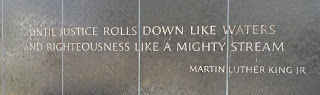
Which is why every April 4th I read or listen to Dr. King's "I Have A Dream" speech, and weep at his loss. And why every July 4th I read the Declaration of Independence. I have set aside days in my year, every year, to read texts like these, texts that have shaped my community. Because these texts aren't done with their shaping. Texts don't hit us once and do all their work; texts seep into us, their words become our words.
Reading and re-reading and reading aloud in communities - these things are like the pouring of water through leaves or grounds - the reading percolates through the words and picks up the essential oils, the savor, the color and taste of the text, and delivers it to us like tea or hot coffee. We taste the words and then the words enter our guts, our veins, our souls.
I recently read an interview with a woman who said "I don't need to go to church to believe those things," referring to her church's beliefs. True. Just as I don't need to go to the gym to get exercise, or to believe that exercise is good for me. But if I don't make a habit of getting exercise, I find I tend not to get what my body needs. The urgent matters in life so easily overwhelm the important ones. Often, when I return from the gym, my wife asks me "How was the gym?" I always think, "It was hard. Everything I do at the gym is difficult." But it is worth doing, because it helps me to maintain my health, and to fight my own decline, to fight the slow slipping away of what I want to hold onto as long as I can. If I do this for my body, why should I not also do it for my heart and mind?
I'm not writing this to endorse all liturgies. I'm confident that there are liturgies that celebrate awful things, and that there are participants in liturgies who make poor use of the liturgies they sit through. As with most of what I write here, I'm trying to sort out what I believe, and why -- as another kind of discipline, one of remembering, and of being mindful of what I believe.
The liturgy of Maundy Thursday is not an easy one, because it reminds me of two things I am capable of: I am capable, like Jesus, of washing others' feet, and of living a life of love; and I am capable, like Jesus' friends, of betraying those people and ideals I most claim to cherish and worship. If my worship is only worship in words, I find it easy to forget to worship what is best with my body, with my life. Liturgies - and we all have liturgies - are the ways I remind my whole person to stop and remember what my words claim so easily to believe.
But I've found I need liturgy in my life. Liturgies help me mark seasons. More than that, liturgies create seasons. That's what I really need, because the creation of seasons becomes, for me, a discipline of memory.
Liturgies help me to count my days, which in turn helps me to make my days count.
I used to chafe at the remembrance of birthdays. Why should one day count more than any other? And why should one day seem more a holiday than another?
I'm slowly getting it. There is nothing special about the day; what is special is the use of the day. Cheerless debunkers never tire of pointing out to me that western Christmas is celebrated on a Roman holiday, that Easter is *really* some kind of fertility rite because it's celebrated in the springtime, that all my holidays don't mean what I think they mean because someone once celebrated them in another way. As though the genealogy of the holiday should be its only meaning, as though the celebrations of the past should have magical power over me, as though I had no power to make the days mean something new to me.
And it is true: holidays and liturgies do have power. As I have said before, what we cherish in our hearts we worship, and what we worship we come to resemble or imitate. Holidays are always about remembering, and remembering is cherishing. Of course, we don't all cherish the same things. Memorial Day is, for some, a remembrance of valor and sacrifice. For others, it is a good day for a picnic with family. Both are forms of cherishing, though the thing cherished is quite different.
Much of the difference probably comes from mindfulness and intention, or lack of intention. Everyone cherishes something, but not all of us think about what we cherish. Liturgies help me to cherish mindfully.

Which is why every April 4th I read or listen to Dr. King's "I Have A Dream" speech, and weep at his loss. And why every July 4th I read the Declaration of Independence. I have set aside days in my year, every year, to read texts like these, texts that have shaped my community. Because these texts aren't done with their shaping. Texts don't hit us once and do all their work; texts seep into us, their words become our words.
Reading and re-reading and reading aloud in communities - these things are like the pouring of water through leaves or grounds - the reading percolates through the words and picks up the essential oils, the savor, the color and taste of the text, and delivers it to us like tea or hot coffee. We taste the words and then the words enter our guts, our veins, our souls.
I recently read an interview with a woman who said "I don't need to go to church to believe those things," referring to her church's beliefs. True. Just as I don't need to go to the gym to get exercise, or to believe that exercise is good for me. But if I don't make a habit of getting exercise, I find I tend not to get what my body needs. The urgent matters in life so easily overwhelm the important ones. Often, when I return from the gym, my wife asks me "How was the gym?" I always think, "It was hard. Everything I do at the gym is difficult." But it is worth doing, because it helps me to maintain my health, and to fight my own decline, to fight the slow slipping away of what I want to hold onto as long as I can. If I do this for my body, why should I not also do it for my heart and mind?
 |
| The words percolate through us, and enter our veins. |
I'm not writing this to endorse all liturgies. I'm confident that there are liturgies that celebrate awful things, and that there are participants in liturgies who make poor use of the liturgies they sit through. As with most of what I write here, I'm trying to sort out what I believe, and why -- as another kind of discipline, one of remembering, and of being mindful of what I believe.
The liturgy of Maundy Thursday is not an easy one, because it reminds me of two things I am capable of: I am capable, like Jesus, of washing others' feet, and of living a life of love; and I am capable, like Jesus' friends, of betraying those people and ideals I most claim to cherish and worship. If my worship is only worship in words, I find it easy to forget to worship what is best with my body, with my life. Liturgies - and we all have liturgies - are the ways I remind my whole person to stop and remember what my words claim so easily to believe.
∞
My Dad Is So Cool
Between 1959 and 1962 my dad worked for NASA. He was an engineer at IBM, who contracted him out to work on our fledgling space program. How cool is that? My dad helped design equipment in the Mercury Control Center at Cape Canaveral. He wasn't an astronaut; he made astronauts possible.
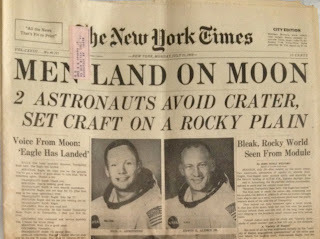 Aristotle knew it: part of human excellence is pursuing knowledge of the world around us - of the cosmos we inhabit. My father isn't a formally trained philosopher, but he was one of the first people to teach me philosophy. Often, on Wednesdays after work, he'd take me out for pizza and cover napkins with chemical formulas, bits of logic, linguistic information he'd learned from reading Chomsky or from studying Russian and French, the history of circuit design, lessons in physics. And I ate it up as readily as I ate up the pizza. He was - and still is, thanks be to God - a man full of wisdom, and that wisdom is evinced by his desire to know more about the world around him.
If that doesn't convince you that my dad is one of the world's coolest dads, consider this: after pizza, he'd always take me to the local arcade and give me half a roll of quarters so I could play video games. The other half of the roll of quarters? He used it to play alongside me.
Thanks, Dad.

If that doesn't convince you that my dad is one of the world's coolest dads, consider this: after pizza, he'd always take me to the local arcade and give me half a roll of quarters so I could play video games. The other half of the roll of quarters? He used it to play alongside me.
Thanks, Dad.
∞
Is Philosophy Useful?
What can you do with a philosophy major? William James quipped that philosophy "bakes no bread." That is, it is not a discipline one studies in order to learn how to practice a particular craft or trade. Philosophy tries to think about and understand everything, which makes it a discipline that does the opposite of specialization.
This leads some people to assume that philosophy is useless. But that is only partly--and largely irrelevantly--true. As Rémi Brague has said, the study of the history of philosophy is freedom. As he puts it, "Dodging history makes us fall prey to doxa." To put it in other terms, if we don't study the history of philosophy, we forget who we are, and believe what we believe without reasons. To be human is to ask who we are; and asking who we are is philosophical.
Let me put this in simpler terms: if you don't ask philosophical questions - and seek their answers - someone else will do it for you. Here's the thing: asking those questions and seeking those answers might be the thing that makes us most human, and most free.
So the answer to my initial question is another question: without philosophy, how will you remain free?
 |
| What does it mean to be human? |
Let me put this in simpler terms: if you don't ask philosophical questions - and seek their answers - someone else will do it for you. Here's the thing: asking those questions and seeking those answers might be the thing that makes us most human, and most free.
So the answer to my initial question is another question: without philosophy, how will you remain free?
∞
The Pastoral And The Personal In Theodicy
Theodicies, like some virtue ethics and certain ontological arguments, are easy targets for refutation, but much depends on the way they are used.
A theodicy is an attempt to reconcile the apparent evil in the world with the alleged goodness of God, often by showing that the very goodness of God makes some evil necessary; or by arguing that the goodness of God is amplified by a certain amount of evil. In other words, the evil we experience and witness is, in the end, made to serve goodness.
When theodicies are spoken publicly and authoritatively, there is a real danger that they will be used to justify further evil. If evil serves good, and evil is easier to accomplish directly than goodness, why not practice evil?
There's also the very real danger that theodicies will isolate us from one another. Sometimes some perversity in us makes us inclined to tell someone who is experiencing fresh grief that "it's all for the good," or "it will all work out well in the end," or "your loved one is now in a better place." I would guess we do this because we do not know what else to say, and because we want the discomfort of grief banished from our presence. In which case we speak those words like an incantation, using magic to make the unpleasantness disappear. But the grief is not detachable from the griever, so to will the banishment of the mourning is to will the death of the mourner. In simpler terms, when we invoke thoughtless theodicies, sometimes we are committing human sacrifice - throwing out the mourner - in order to comfort ourselves.
In spite of this, I think there is still a place for theodicies - just as there is a place for ontological arguments - provided they originate with the believer and are not forced upon her. The mourner who chooses to believe that the dearly departed have gone to well-earned rest may believe that. That belief may be the germination of the seeds of honor and love, or the expression of grief combined with commitment to the flourishing of the memory of the beloved - it may be the fruit of the idea that the cosmos has no right to bring this love to an end. You may destroy the body, but the soul you shall not take from me.
Of course, the mourner's grief should not turn into fixed doctrine for the rest of us, either. Some things we simply don't know. Death is a horizon we pass only once, a boundary that few - if any - signs are allowed to pass over. But precisely because we do not know what comes after - because we do not even know ourselves much of the time - we may allow others what they need to endure their losses, neither forcing our justifications of evil upon them, nor denying them the explanations that may give them the comfort their hearts need.
A theodicy is an attempt to reconcile the apparent evil in the world with the alleged goodness of God, often by showing that the very goodness of God makes some evil necessary; or by arguing that the goodness of God is amplified by a certain amount of evil. In other words, the evil we experience and witness is, in the end, made to serve goodness.
 |
| Roman tombs in southern Crete. |
There's also the very real danger that theodicies will isolate us from one another. Sometimes some perversity in us makes us inclined to tell someone who is experiencing fresh grief that "it's all for the good," or "it will all work out well in the end," or "your loved one is now in a better place." I would guess we do this because we do not know what else to say, and because we want the discomfort of grief banished from our presence. In which case we speak those words like an incantation, using magic to make the unpleasantness disappear. But the grief is not detachable from the griever, so to will the banishment of the mourning is to will the death of the mourner. In simpler terms, when we invoke thoughtless theodicies, sometimes we are committing human sacrifice - throwing out the mourner - in order to comfort ourselves.
In spite of this, I think there is still a place for theodicies - just as there is a place for ontological arguments - provided they originate with the believer and are not forced upon her. The mourner who chooses to believe that the dearly departed have gone to well-earned rest may believe that. That belief may be the germination of the seeds of honor and love, or the expression of grief combined with commitment to the flourishing of the memory of the beloved - it may be the fruit of the idea that the cosmos has no right to bring this love to an end. You may destroy the body, but the soul you shall not take from me.
 | ||
| My great aunt and great uncle. Here lie their bodies. |
∞
A Gift Of A Sponge
My father bundled us into our hats and coats and then into his little red VW and drove us to the Caldor store in Kingston. The first Christmas I can now remember was fast approaching, and he wanted my brother, my sister and me to choose gifts for our mother.
I had no idea how to shop, of course, so my father asked me to think about what my mother liked. The only thing I could think was that I often saw her cleaning things: washing dishes, cleaning floors and windows, doing laundry. Obviously, she must like cleaning quite a lot.
So I decided to buy her a sponge.
My father balked at this, but I insisted. This is what she likes, this is what I want to buy.
Two events that followed have imprinted themselves forever on my memory, have made me forever grateful to my parents.
First, Dad let me buy it. It's not at all what he would have chosen. But he gave me the gift of letting me decide, the gift of the long, slow welcome into responsible adulthood.
Second, mom loved it. Let me clarify that: she loved the gift, and she thanked me warmly and genuinely, smilingly. And so she gave me a gift as well, the gift of teaching me how to receive the offerings of others with grace; the gift of her love that consecrated my poor offering.
Both of them gave me another gift as well, of course: I had no money to buy the sponge, so I used theirs. I took their money and spent it on what they did not need, on a gift that, coming from another person or from me at a different age, would have been offensive. They gave me the gift of ennobling my shabby token into a gift of great worth.
No year of my life has passed in which I have not thought of that kitchen sponge. It reminds me that no act of kindness towards a child is wasted. It reminds me of my parents' love for me, love that I fumblingly attempt to pass on to my children as I seek to give them the difficult gift of autonomy.
And my parents, in that Christmas, gave me hope that the poor offerings of my worship - in which I spend what is not really mine in order to give a gift that is not really needed - might really matter, not because they are intrinsically great, but because of the love and grace with which they might be received, and consecrated.
I had no idea how to shop, of course, so my father asked me to think about what my mother liked. The only thing I could think was that I often saw her cleaning things: washing dishes, cleaning floors and windows, doing laundry. Obviously, she must like cleaning quite a lot.
So I decided to buy her a sponge.
My father balked at this, but I insisted. This is what she likes, this is what I want to buy.
Two events that followed have imprinted themselves forever on my memory, have made me forever grateful to my parents.
 |
| Dad and Mom were young once, too. |
Second, mom loved it. Let me clarify that: she loved the gift, and she thanked me warmly and genuinely, smilingly. And so she gave me a gift as well, the gift of teaching me how to receive the offerings of others with grace; the gift of her love that consecrated my poor offering.
Both of them gave me another gift as well, of course: I had no money to buy the sponge, so I used theirs. I took their money and spent it on what they did not need, on a gift that, coming from another person or from me at a different age, would have been offensive. They gave me the gift of ennobling my shabby token into a gift of great worth.
No year of my life has passed in which I have not thought of that kitchen sponge. It reminds me that no act of kindness towards a child is wasted. It reminds me of my parents' love for me, love that I fumblingly attempt to pass on to my children as I seek to give them the difficult gift of autonomy.
 |
| A gift from my students; it means more to me than words can easily say. |
And my parents, in that Christmas, gave me hope that the poor offerings of my worship - in which I spend what is not really mine in order to give a gift that is not really needed - might really matter, not because they are intrinsically great, but because of the love and grace with which they might be received, and consecrated.
∞
Love One Another: Prisons and Devotion to Enemies
In his first book, Stride Toward Freedom, Dr. King wrote "We adopt the means of nonviolence because our end is a community at peace with itself." Paraphrasing Gandhi, he added a word for those who considered themselves his enemies, "In winning our freedom we will so appeal to your heart and conscience that we will win you in the process."
This is a radical idea, one that is like the ideas of Jesus and St Paul that we should love our enemies. If your mind does not stumble over those words, you might be a saint; or you might not be listening to them.
King's argument is that we need our enemies. They need us to make them into the kind of people who embody love, not hatred. And we need - in the depths of our souls - the work of loving them in such a way that we win them over to the side of love and away from the crippling hatred that owns them.
It is easy to say "that's fine for church," or "I will love my enemy in my heart but in my life I will punish him." But what would happen if we thought of our worst enemies - I have in mind criminals and terrorists, the people we most seem to fear - as people with a "heart and conscience" that could be won. As people without whom we are incomplete.
We're good at finding ways to make people pay for their wrongdoing. We have great technology for warfare, and a brilliant system of criminal investigation and prosecution, perhaps the best history has ever seen. I don't propose eliminating those things. Instead, I am asking this: what if we decided that we would put the same creative energy and financial resources that have gone into creating our fine military, police, and courts into winning the consciences of our enemies?
When it comes to our anti-terror policies, I don't see what we can do to win terrorists' consciences, other than living our lives in such a way that anyone who supports our would-be enemies must feel shame at hating such virtuous people. That sounds to me like an end worth pursuing for its own sake, after all.
As for our prisons, our prisons seem to be good at exposing non-criminals to criminals; and to exposing criminals to more criminals, breeding gang culture. Violent criminals surely merit our censure, extraction from society, and punishment. But that doesn't mean our hearts need to be full of a desire for vengeance.
I'm not good at this, but I'm trying to become the kind of person who regards criminals as people I need, who need me to love them, who need me to win their consciences.
I believe a society needs to be prepared to use force against those who would forcefully harm others. But increasingly I am coming to believe that individuals in each society also need to be prepared to fight fire not with fire but with the healing waters of love, waters that overflow from hearts that daily struggle to regard the people we most hate and fear as the people we also most need to love. It's not easy. But it may be the only way to become "a community at peace with itself."
This is a radical idea, one that is like the ideas of Jesus and St Paul that we should love our enemies. If your mind does not stumble over those words, you might be a saint; or you might not be listening to them.
King's argument is that we need our enemies. They need us to make them into the kind of people who embody love, not hatred. And we need - in the depths of our souls - the work of loving them in such a way that we win them over to the side of love and away from the crippling hatred that owns them.
It is easy to say "that's fine for church," or "I will love my enemy in my heart but in my life I will punish him." But what would happen if we thought of our worst enemies - I have in mind criminals and terrorists, the people we most seem to fear - as people with a "heart and conscience" that could be won. As people without whom we are incomplete.
We're good at finding ways to make people pay for their wrongdoing. We have great technology for warfare, and a brilliant system of criminal investigation and prosecution, perhaps the best history has ever seen. I don't propose eliminating those things. Instead, I am asking this: what if we decided that we would put the same creative energy and financial resources that have gone into creating our fine military, police, and courts into winning the consciences of our enemies?
When it comes to our anti-terror policies, I don't see what we can do to win terrorists' consciences, other than living our lives in such a way that anyone who supports our would-be enemies must feel shame at hating such virtuous people. That sounds to me like an end worth pursuing for its own sake, after all.
As for our prisons, our prisons seem to be good at exposing non-criminals to criminals; and to exposing criminals to more criminals, breeding gang culture. Violent criminals surely merit our censure, extraction from society, and punishment. But that doesn't mean our hearts need to be full of a desire for vengeance.
 |
| "Peace." Over the head of the angel of peace in Bruton Parish, Williamsburg, VA. |
I believe a society needs to be prepared to use force against those who would forcefully harm others. But increasingly I am coming to believe that individuals in each society also need to be prepared to fight fire not with fire but with the healing waters of love, waters that overflow from hearts that daily struggle to regard the people we most hate and fear as the people we also most need to love. It's not easy. But it may be the only way to become "a community at peace with itself."
*****
I have written two other posts about prisons, and Charles Peirce's reasons why our current system is a mark of insanity--or at least that it evinces a serious lack of love--here and here.
∞
A number of times in the last few years I've read statements by prominent scientists about the irrelevance of philosophy, echoing Richard Feynman's famous quip that "Philosophy of science is about as useful to scientists as ornithology is to birds."
Feynman was just talking about philosophers of science, which is just one narrow slice of the philosophic pie. More recently others, like Freeman Dyson, have made broader indictments of philosophy, or like Lawrence Krauss, of the humanities generally.
Dyson, in an article he wrote for the New York Review of Books, described today's philosophers as "a sorry bunch of dwarfs. They are thinking deep thoughts and giving scholarly lectures to academic audiences, but hardly anybody in the world outside is listening. They are historically insignificant." Yes, we have a technical vocabulary that outsiders often have trouble understanding. But that's true of every discipline. And yes, we don't seem to have anyone in our discipline who is writing the next Job or Republic right now, but that's been true almost always. No discipline consistently produces nothing but geniuses. Many of us in every discipline live our careers out bearing the gifts of the past forward to another generation so that they might benefit from them and add to them. And many of us are content to be forgotten as long as the books of wisdom entrusted to us are remembered.
In his recent book A Universe From Nothing, Krauss seems to be at pains to point out that without the sciences, the humanities are virtually useless, and that even with the sciences, the humanities are still virtually useless. His introduction pushes the humanities back at arm's length and invites them to clear out while science handles all the real heavy lifting.
What stands out for me as I read these scientists and some others writing in a similar vein is that they write like they're on the defensive and feeling embattled. My guess is that they see themselves or their disciplines as being engaged in an important fight about cultural values, science education, and research funding. The outsized reaction to Thomas Nagel's recent Mind and Cosmos - with its inflammatory subtitle, "Why The Materialist Neo-Darwinian Conception of Nature Is Almost Certainly False" - suggests that many advocates of the sciences worry about any book that might give comfort to the enemy.
A siege mentality can make us distrustful of everyone, and especially of our critics, no matter how friendly. Dyson, Krauss, and others inclined to sideline the humanities would do well to remember that the humanities give them the tools with which to reason and write about the discoveries of science. If those of us in the humanities seem critical of the sciences, this doesn't mean we're unfriendly. The funny thing about Feynman's dictum is that as long as birds and people try to live together, birds actually do benefit from ornithologists. After all, ornithologists study the birds and their environments, and work to ensure that others see how important it is to preserve them. Of course, the birds in their daily lives will likely never know it.
I should add that philosophers like me benefit from ornithologists, too. I am especially grateful for the ornithologists at Cornell University for putting so much helpful information on their website for bird-watchers and ornithophiles like me.
The bird I have identified as a Cooper's hawk might be a sharp-shinned hawk; I often have trouble distinguishing them. We live on the migration path for ruby-throated hummingbirds, so we see them for two brief seasons, once in the spring and again in the fall. Mourning doves are notoriously poor parents, and we often find they've laid eggs in silly places. Fortunately for their species, they can produce multiple clutches each year.
If you're interested in both birds and philosophy, let me recommend Charles Hartshorne's book Why Birds Sing. Hartshorne suggests that maybe birds sing because they enjoy it. This may seem so obvious as to be silly, but it is a helpful addition to the usual claims that birds sing because singing is useful for mating, staking territorial claims, self-defense, and so on. Hartshorne doesn't allow us to reduce birds to bird-making machines. Which is helpful, because it's a reminder that we, too, are more than human-making machines. It's also good to be reminded that it's okay to sing for the sheer enjoyment of singing.
Do Birds Need Ornithologists?
 |
| Cooper's hawk in my backyard. |
Feynman was just talking about philosophers of science, which is just one narrow slice of the philosophic pie. More recently others, like Freeman Dyson, have made broader indictments of philosophy, or like Lawrence Krauss, of the humanities generally.
Dyson, in an article he wrote for the New York Review of Books, described today's philosophers as "a sorry bunch of dwarfs. They are thinking deep thoughts and giving scholarly lectures to academic audiences, but hardly anybody in the world outside is listening. They are historically insignificant." Yes, we have a technical vocabulary that outsiders often have trouble understanding. But that's true of every discipline. And yes, we don't seem to have anyone in our discipline who is writing the next Job or Republic right now, but that's been true almost always. No discipline consistently produces nothing but geniuses. Many of us in every discipline live our careers out bearing the gifts of the past forward to another generation so that they might benefit from them and add to them. And many of us are content to be forgotten as long as the books of wisdom entrusted to us are remembered.
 |
| Female ruby-throated hummingbird. |
In his recent book A Universe From Nothing, Krauss seems to be at pains to point out that without the sciences, the humanities are virtually useless, and that even with the sciences, the humanities are still virtually useless. His introduction pushes the humanities back at arm's length and invites them to clear out while science handles all the real heavy lifting.
What stands out for me as I read these scientists and some others writing in a similar vein is that they write like they're on the defensive and feeling embattled. My guess is that they see themselves or their disciplines as being engaged in an important fight about cultural values, science education, and research funding. The outsized reaction to Thomas Nagel's recent Mind and Cosmos - with its inflammatory subtitle, "Why The Materialist Neo-Darwinian Conception of Nature Is Almost Certainly False" - suggests that many advocates of the sciences worry about any book that might give comfort to the enemy.
 |
| Mourning dove eggs in one of my flower pots. |
******
I should add that philosophers like me benefit from ornithologists, too. I am especially grateful for the ornithologists at Cornell University for putting so much helpful information on their website for bird-watchers and ornithophiles like me.
The bird I have identified as a Cooper's hawk might be a sharp-shinned hawk; I often have trouble distinguishing them. We live on the migration path for ruby-throated hummingbirds, so we see them for two brief seasons, once in the spring and again in the fall. Mourning doves are notoriously poor parents, and we often find they've laid eggs in silly places. Fortunately for their species, they can produce multiple clutches each year.
If you're interested in both birds and philosophy, let me recommend Charles Hartshorne's book Why Birds Sing. Hartshorne suggests that maybe birds sing because they enjoy it. This may seem so obvious as to be silly, but it is a helpful addition to the usual claims that birds sing because singing is useful for mating, staking territorial claims, self-defense, and so on. Hartshorne doesn't allow us to reduce birds to bird-making machines. Which is helpful, because it's a reminder that we, too, are more than human-making machines. It's also good to be reminded that it's okay to sing for the sheer enjoyment of singing.
∞
Drones and Virtue
My latest article, on UAV (drone) warfare and virtue ethics, co-authored with John Kaag. It's behind a paywall, but your local library might have a subscription to the Chronicle of Higher Education where you can see it in print (in the Chronicle Review, March 11, 2013) or through their library website.